
CHEEK ISOLATION:
By isolating our cheek cells, we can determine whether or not we have a version of a gene, or allele. PV92 is a gene that can change for each individual. Everyone has two pairs of genes (one from their mom, one from their dad). Those with the PV92 Alu allele will have extra nucleotides. Their DNA will be heavier from people with the other version of the gene (941 base pairs versus 641 base pairs). For people who have genes that have both the PV92 Alu gene, all their DNA will be 941 base pairs long. For those who do not, their DNA will be 641 bp long. For those who have one version of the gene from each parent (heterozygous), they will have some DNA that are two different weights.
Steps:
-
ISOLATE THE CELLS: Gurgle water with salt (0.9% salt, 99.1% water; weight by volume 1 gram per 100 milliliters = 1%). Salt will make the solute concentration of the solution isotonic, so the cells will not explode too quickly; we want to isolate the cells from the water without exploding them. Then we centrifuge the solution so that a pellet of cells sinks at the bottom. It’s a white spot on the bottom!
-
BREAK (Lysing) OPEN THE CELLS: Mix the cells with a solution that will protect the cells. Then we will use a water bath to heat up our samples of our cells to break open the cells. Now inside the tubes, we have floating DNA but also a lot of other stuff. We want to now get a lot of the DNA through amplification.
-
AMPLIFY THE DNA: In order to amplify the DNA, we use PCR (polymerase chain reaction).
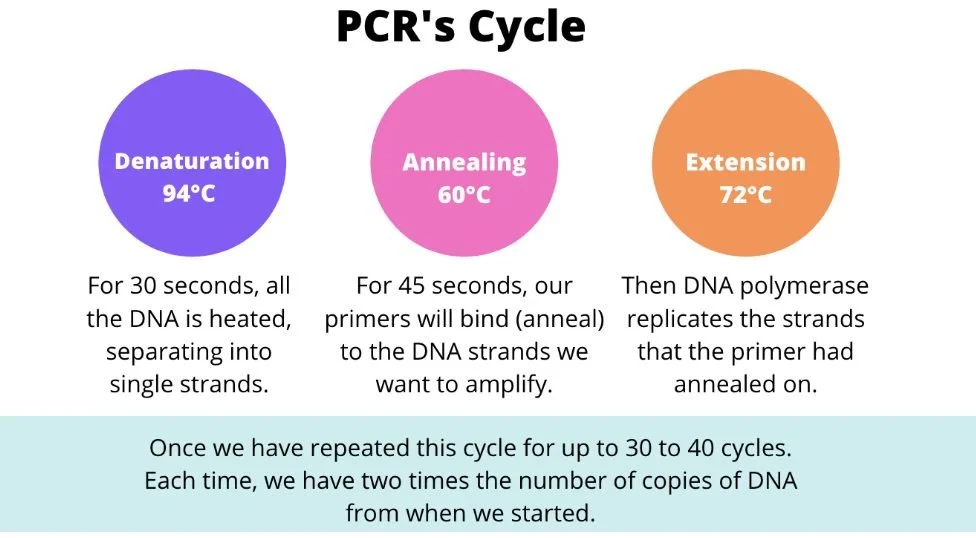
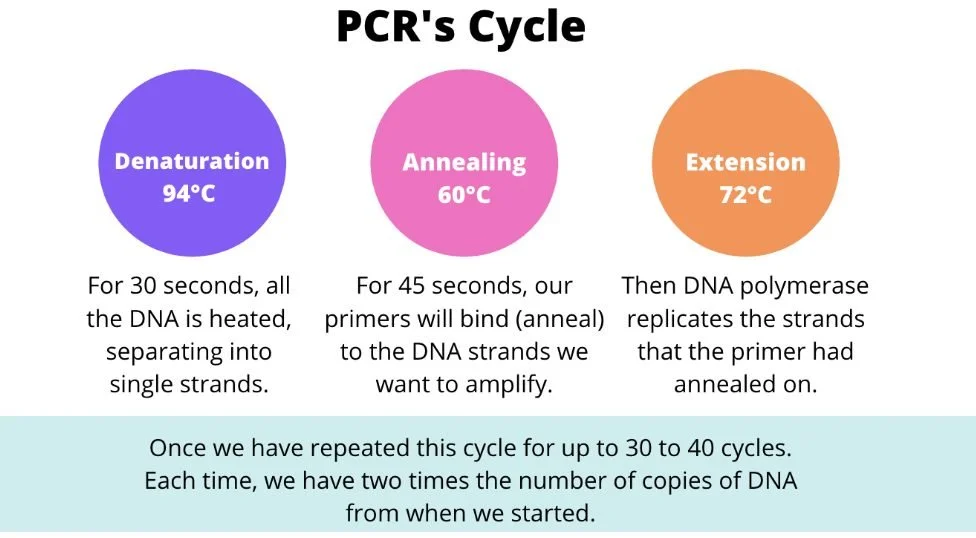
PCR (polymerase chain reaction) is able to find a certain type of gene and replicate it (amplification) so that there are many copies of that same gene in the sample. This happens through a thermal cycle, where DNA samples are heated and separated into single strands. Here are the steps of the thermal cycle.
-
We need two different oligonucleotide primers, which will anneal to opposite ends of the opposite strands of the DNA we want to replicate.
-
So, before we amplify the DNA, we have to identify both opposite strands of DNA we want to amplify. Since DNA polymerase can only replicate preexisting strands, the primers allow it to replicate the strand that we want.
-
The DNA polymerase is Taq polymerase, a thermally stable polymerase from a bacteria called Thermus aquaticus that can survive very hot environments (like in a steam vent).
Now let’s see the steps of how strands of DNA get replicated:
You can use gel electrophoresis to separate the different weights of DNA to determine what allele you have. Gel electrophoresis will be covered in a different article!
