A 22-year-old woman presented to the emergency department reports no abdominal pain nor nausea, but blurry vision. On physical examination, temperature was 37.2°C; pulse rate, 100 beats/min; blood pressure, 132/50 mm Hg in the sitting position; and respirations, 16 breaths/min. Lungs were clear to auscultation (when you listen to the sounds using a stethoscope), and cardiac, abdominal, and neurologic examination findings were normal. Besides her blurry vision, no ophthalmic (eye-related) changes were reported. Laboratory studies revealed a low serum bicarbonate level, which is important in your kidneys when there is metabolic acidosis (an imbalance of acids to bases due to kidneys excreting excess acid). When we test her urine, we find no physical hints, no cells or crystals. You take an EtG test, to measure ethanol, acetone, and isopropyl alcohol. Negative.
She comes from the mobile park, living in a trailer all the way from the San Joaquin Valley, and she feels pain, asking to rest. You administer IV fluid and give her Tylenol (taking things with aspirin can cause stomach irritation), and think about what is going on.
The next morning, it is reported that the woman has a concentration of 71 mg/dL of methanol in her blood. Antizol is administered, which is a medication used for methanol poisoning by inhibiting the breakdown of methanol into formic acid, which becomes toxic to us as formaldehyde, which causes drowsiness, confusion, ataxia (loss of muscle control), neurological disorders, and death. The patient is immediately given dialysis for 4 hours and hospitalized for two more days until she is discharged.
The day the woman is discharged, you discover that her neighborhood had a gas line break, releasing antifreeze into her local water reservoir. Unlike her other fellow residents, the patient continued to drink tap water so she could buy bottled water for her children. Unbeknownst to her, her water facility did not filter these toxic chemicals, and the facility did not detect the chemical until her family had reported it the day she came to the hospital.
This occurrence reflects on the methyl found by the United States Environmental Protection Agency’s list of water bodies that did not pass the U.S. standards for safe drinking water in California. Other bodies of water, mainly in the Central Valley, had cases of different pesticides such as chlorpyrifos, diuron, and parathion as well as fecal bacteria. While some argue that these pesticides, when given in low doses, are not harmful to humans, increased research comes with different cases of neurotoxicity and carcinogens in these pesticides, and all of these chemicals have been labeled so by the Globally Harmonized System of Classification and Labeling of Chemicals, or GHS.
In the following paper, we will dive deeper into California’s untold water crisis and how private water companies are able to get away with pesticides and other harmful chemicals in the water of innocent people.
Abstract
In 2012, California law (Assembly Bill 685) declared that every person in the state has a right to clean, safe, and affordable water. Yet, according to a study at UC Davis, at least 44,000 residents get their water from Community Water Services that are not compliant with the United States’ Safe Water Drinking Act (SWDA) in the San Joaquin Valley (London et al., 2018). In the Central Valley, where over 3 million people reside, many farmers and workers crucial to the agricultural economy of California still do not have reliable sources of water, and they are forced to buy water from small private stores, which leads to an untraceable underground economy that the government cannot track or tax.
As a result, it becomes crucial that the government enforces the SWDA in California in order to ensure the health of many disadvantaged Californians and sustain the water and agriculture economy, as well as restoring local wildlife.
Introduction
The Safe Drinking Water Act is a federal law in the United States that is intended to ensure that all water used by United States citizens is clean to drink and use by public water systems. It measures the maximum contaminant level (MCL) inside water for disinfectants, microorganisms (e.g. coliform), inorganic and organic chemicals (e.g. pesticides, lead, and copper), and radionuclides (e.g. radium and uranium).
As a result, in 1969, legislators Carley V. Porter and Gordon Pologne passed the California Water Code, also known as the Porter-Cologne Act, in 1969. The California Water Code enforced regulations on what defined safe water, and it has been critical in establishing standards for water quality ever since. In 1972, the Clean Water Act (CWA) established basic standards for safe water, followed by the Safe Drinking Water Act in 1974.
The Safe Drinking Water Act is a federal law in the United States that is intended to ensure that all water used by United States citizens is clean to drink and use by public water systems. It measures the maximum contaminant level (MCL) inside water for disinfectants, microorganisms (e.g. coliform), inorganic and organic chemicals (e.g. pesticides, lead, and copper), and radionuclides (e.g. radium and uranium). Similarly, the Clean Water Act in California lists standards for different pollutants, and it keeps track of all public water systems.
Despite all the work done to keep water clean and government companies accountable, the Clean Water Act cannot protect citizens who use privately owned water systems. To this day, almost 50 years after it has been effective, there are still countless water systems that provide California citizens with unclean and unreliable drinking water. In a 2018 study conducted by a team of researchers at UC Davis, the majority of community water systems in the San Joaquin Valley were privately owned, small, and not regulated (London et al.). Since 2011, this has already been a problem: the San Joaquin Valley has one of the most contaminated water systems in the country.
In its most recent 2018 report, the United States Environmental Protection Agency (EPA) has noted over 974 cases in the state where there had been pesticides, bacteria, toxic metals, and trash in drinking water all over the state. Most notably, where most of the freshwater comes from the San Joaquin River and neighboring bodies, the Central Valley has the most cases of pollution and unsafe drinking water (2018). While the Central Valley supplies the majority of the agricultural economy in California, it is the center of pollution poisoning for low-income farmers and tenants. It reveals a long history of worker oppression, with farmers being forced to work in conditions vulnerable to the surrounding pesticides and unable to even use a proper bathroom. Creeks filled with fecal coliform and dozens of different types of pesticides and herbicides have been found in the San Joaquin River, rivers just off from Los Angeles, and Santa Clara County.
Moreover, California has done little in enforcing regulations of private water systems that pass these rivers and creeks. Even though the state recognizes that the freshwater and environment had been polluted through commercial farming practices, many rural communities still receive water from water systems that are inadequate. Since many of these communities support farmers, these communities are scattered, and one general water system would have to access uneven terrain. While cities may receive water from a government-funded water system, many live outside the city where housing prices are not as high, but water quality significantly worse. In the end, low-income communities are driven outside adequate living conditions, where inadequate basic resources is the price to pay. But when privately owned companies violate the right to water, it becomes more than a threat to not only those who cannot afford their water bill, but to our basic human rights.
California was the first state in the country to recognize the Human Right To Water (California Legislative Assembly 2012). And yet, some companies take advantage of the fact that low-income communities living outside big cities cannot trust the water quality of private water systems that ship water from polluted aquifers to the homes of over millions of people each day. Waterias are small stores that market water to local communities with filtered water which people buy in hopes of not being poisoned by arsenic or a pesticide.
But this places low-income communities in a dilemma -- can they afford the exorbitant prices of “better” drinking water, or shall they trust the tap water at home, to eat an extra meal? This problem has been exacerbated by the California drought in 2014. According to the U.S. Department of Energy, the water rates prices continue to increase faster than our rate of inflation and income (as much as 7.3%, compared to the inflation rates of 2.14% and income increase estimates of 1.8% to 3.3%) (2017). In essence, the human right to water for “safe, clean, affordable and accessible water” has not been safe or affordable.
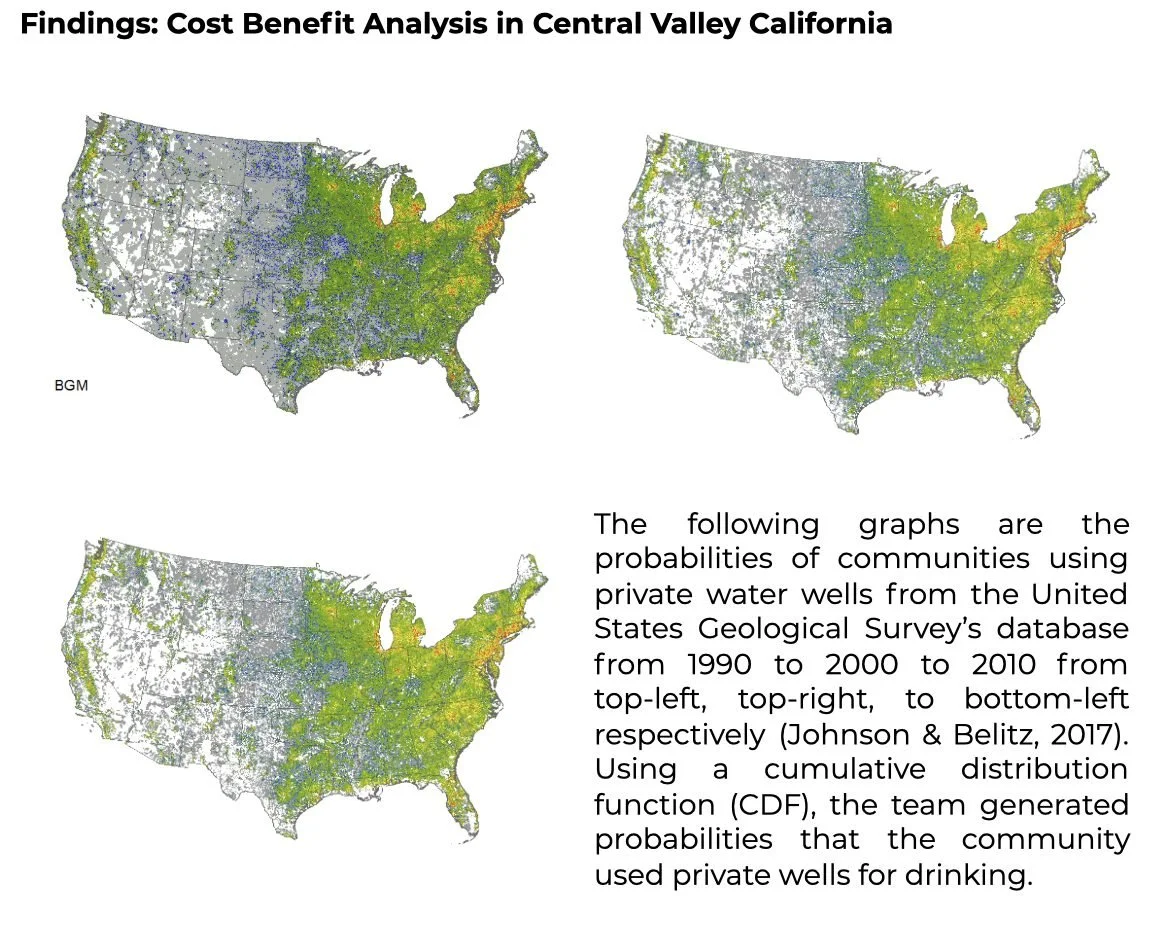
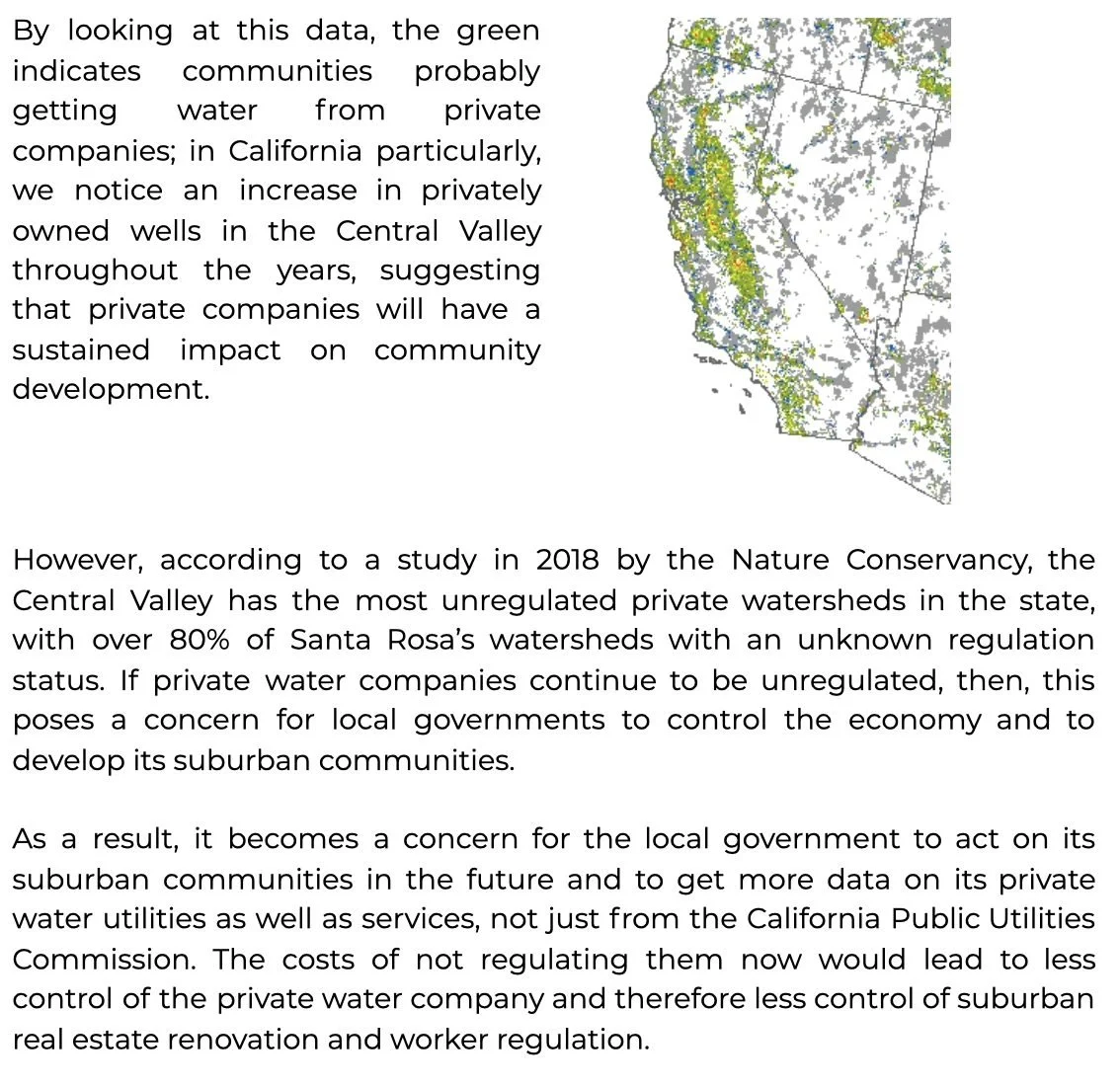
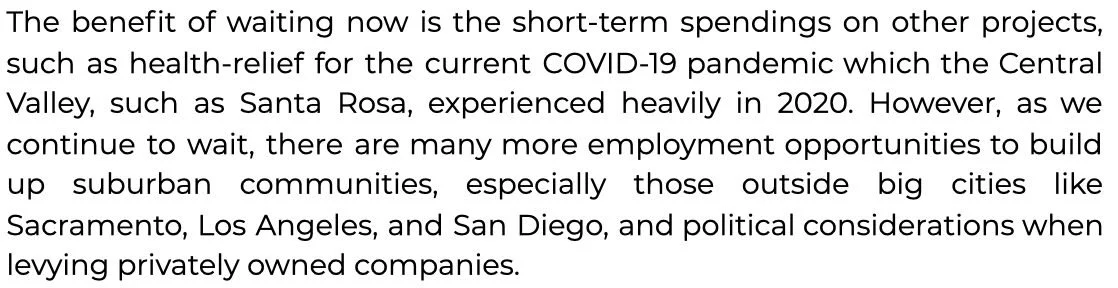
Methods & Findings: Cost Benefit Analysis in Central Valley California
Discussion & Conclusion
In the past, suggested policy changes have been to make more stringent standards for public water systems. In the study from UC Davis, the researchers suggested including disadvantaged communities in the California Water Action Plan, standards for what the human right to water should be, and further recognition in city planning departments to consider how to rebuild their suburban communities. In the last decade, some progress has been made. As part of the Safe and Affordable Funding for Equity and Resilience (SAFER) program, Governor Newsom proposed the Senate Bill 200 (SB 200): the Safe and Affordable Drinking Water Fund. This fund uses public funds from taxes to provide $130 million per year “to develop and implement sustainable solutions for small systems with violations of drinking water standards” (2019). More than ever, the state has put effort into providing ways that citizens can get safe water with the government.
However, the problem still remains with private water companies. Instead of the U.S. EPA, the California Public Utilities Commission is the one who regulates private water utilities. This commission, however, regulates private water utilities once there have been complaints filed against a particular company, and they take cases individually. Many private companies’ facilities are not regulated, and many families have to test their water by testing the taste of their water. Sometimes, if the water is contaminated by a tasteless metal, the results can be fatal to the local community, causing a public health concern.
The problem no longer becomes a problem with regulating just public water systems but one with all water systems. It is critical that California adopts the human right to water as a basic human right, such as the right for fair trial, for not only public jurisdiction but also private. In the same way, water should be regulated in both public and private contexts, from the water reservoirs that we have to the systems that we use to transport water to the homes that receive it. Stringent enforcement does not mean just recognizing it on our bill; it requires the state to establish penalties for those who do not have adequate facilities and rewards to those who do.
Diverting our taxes to fixing past faults in following regulations does not solve the problem. It only reveals how many years the public has allowed its water systems to be under-patrolled and how we continue to do so with our private water utilities. Instead, we propose taking an additional tax from both private and public water companies who violate these regulations in order to mandate proper water reform. Using the funding from the SAFER program, we instead use these funds to build more community water programs and build suburban communities for the farmers and tenants. By building these communities outside of cities, this creates room for the real estate economy for the cities as well as homes for workers on farms. This allows the government to keep track of workers more easily, thereby establishing more sanitary communities, preventing public health outbreaks, and closing the gap between low-income communities. Our job to protect a basic human right no longer becomes a battle to fix our past mistakes but a necessity to ensure that all homes may access clean and affordable water.
Citations
A.B. 685, 2012. Reg. Sess. (Ca. 2012). http://www.leginfo.ca.gov/pub/11-12/bill/asm/ab_0651-0700/ab_685_bill_20120925_chaptered.pdf
Bunch S., Cort K., Johnson E., Elliott D., McMordie Stoughton K. United States Department of Energy, Office of Energy Efficiency & Renewable Energy. 2017. Water and Wastewater Annual Price Escalation Rates for Selected Cities across the United States. https://www.energy.gov/sites/prod/files/2017/10/f38/water_wastewater_escalation_rate_study.pdf Retrieved June 2021.
California Water Boards. Port-Cologne Water Quality Control Act. Water Code Division 7 and Related Sections. https://www.waterboards.ca.gov/laws_regulations/docs/portercologne.pdf
Copeland, Claudia (2016-10-18). Clean Water Act: A Summary of the Law (Report). Washington, D.C.: U.S. Congressional Research Service. RL30030. https://fas.org/sgp/crs/misc/RL30030.pdf
Crumpton TL, Seidler FJ, Slotkin TA. 2000. Developmental neurotoxicity of chlorpyrifos in vivo and in vitro: effects on nuclear transcription factors involved in cell replication and differentiation. Brain Res. 857(1-2):87-98.
Johnson, T.D., Belitz, K., Lombard, M.A., 2019, Domestic well locations and populations served in the contiguous U.S. for 2000 and 2010, Science of the Total Environment 687, pp. 1261-1273. IP-101767, https://doi.org/10.1016/j.scitotenv.2019.06.036.
Johnson, T.D., and Belitz, Kenneth, 2017, Domestic well locations and populations served in the conterminous U.S.: 1990: U.S. Geological Survey data release, https://doi.org/10.5066/F7028PSX.
London J., Fenci A. Watterson S., Jarin J., Aranda A., King A., Pannu C., Seaton P., Fireston L., Dawson M., Nguyen P. 2018. The Struggle for Water Justice: Disadvantaged Unincorporated Communities in California’s San Joaquin Valley. https://regionalchange.ucdavis.edu/sites/g/files/dgvnsk986/files/inline-files/The%20Struggle%20for%20Water%20Justice%20FULL%20REPORT_0.pdf
The Nature Conservancy of California. 2012. Where Does California’s Water Come From? Land conservation and the watersheds that supply California’s drinking water. https://www.nature.org/media/california/california_drinking-water-sources-2012.pdf
United States. Pub.L. 99–359; 100 Stat. 642. "Safe Drinking Water Act Amendments of 1986." 1986-06-19. https://www.epa.gov/sites/production/files/2020-05/documents/safe_drinking_water_act-title_xiv_of_public_health_service_act.pdf
United States Environmental Protection Agency. 2021. Actions for Cleaner Water. https://www.epa.gov/sanjoaquinvalley/actions-cleaner-water
United States Environmental Protection Agency. 2018. EPA Review of California’s 2014-16 CWA Section 303(d) List. https://www.waterboards.ca.gov/centralvalley/water_issues/tmdl/impaired_waters_list/2014_int_rpt_dev/2014_2016_int_rpt/2018_0406_usepa_appr_ltr_final.pdf