
Happy Thursday again!
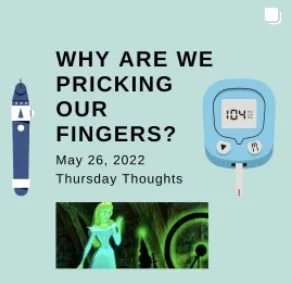
Today I was measuring my grandmother’s blood sugar levels, and I found out that we are one of the many who still prick our grandmother’s fingers instead of using the new continuous glucose monitoring systems.
These monitors are like patches that are inserted by a patient’s doctor underneath their skin, and one can use their phone to track their glucose levels. Abbott, for example, has developed an app that tracks glucose levels throughout the day while also giving alerts when someone’s blood sugar levels are too low/too high.
But my grandma has sensitive skin, so she can’t have a sticker-like circle attached onto her skin 24/7. Plus, most of these sensors only last up to 90 days, so they have to be regularly inserted by the doctor, which can lead to itchy and irritated skin.
Also, how does my grandma’s at-home pricker work anyways?
Apparently, there’s a lot that someone can look into with this:
-
Current models of glucose monitoring that use lancets (those prickly things) actually use electrical signals to estimate the concentration of blood sugar. Collected glucose from the blood reacts with glucose oxidase, which reduces another agent called a mediator reagent. The mediator then gets oxidized at an electrode, generating an electric current which gets measured. If there is more glucose, then more electricity that gets generated, which gets read as higher sugar levels.
According to this article by NIH, there are plenty of other non-invasive methods I haven’t looked into (https://www.ncbi.nlm.nih.gov/pmc/articles/PMC7731259/):
-
Apparently, the best way to measure blood sugar without blood is with interstitial fluid (ISF) which is the fluid surrounding cells.
-
Hm, there are some scientists trying to use nanotechnology to extract ISF without causing so much bleeding: https://www.pnas.org/doi/10.1073/pnas.1716772115.
-
There’s also been some research using types of infrared light to measure blood sugar: https://pubmed.ncbi.nlm.nih.gov/14639751/ and https://pubmed.ncbi.nlm.nih.gov/16613642/ .
So my question is: what’s the problem with them?
-
My guess is that nanotechnology has not yet figured out how to measure blood sugar the same way current blood sugar monitors can. If we extracted very few glucose molecules floating in the interstitial fluid, it may not accurately represent the glucose on our red blood cells. Is there nanotechnology already in place that can extract minimal amounts of red blood cells as well?
-
When using infrared light and other methods that don’t involve blood, apparently we need to be mindful of “the parameters and their vibration ranges” which can affect the readings -- what exactly are the parameters we are talking about?
If you are a student interested in learning more about diabetes, maybe you can also help answer these questions. I chose these articles because they are from more credible sources, and perhaps you can add on (with actual APA formatting!) with your own research at Teens In Health’s 2022 Summer Researchathon!
Teens In Health’s 2022 Summer Researchathon will be a flexible, six-week research opportunity for high schoolers to lead their own research project throughout the summer and publish our website. To apply, please visit our website at www.teensinhealth.org.
As always, let’s keep asking questions and finding answers!
