
Billie Eilish? BTS? Many pop musicians have risen to fame through their voices -- all thanks to their brain’s ability to control them. The brain has amazed scientists for centuries -- its complexity has always baffled philosophers. When Charles Darwin released his idea of “natural selection” as a way of evolution, many people always wondered how his simple theory could produce something as complex as the brain. Moreso, how has the brain evolved to allow us to speak, to sing, and to communicate? In this report, let us take a journey -- an evolutionary journey -- of the laryngeal motor cortex.
The aspect of the brain I am looking at regards the evolution of language, more specifically from the primate communication system to its evolution to words and different languages. Over the years, there are many aspects regarding the elements of the brain that contribute to the evolution of communication to what we are familiar with. However, the three most key aspects of communication specific to humans are the control of vocal tracts and vocal cords, the need for communication, and the hierarchical syntax in language. To further understand the evolution of language, we must first understand the evolution of our brain that supports the advances of speech and language.
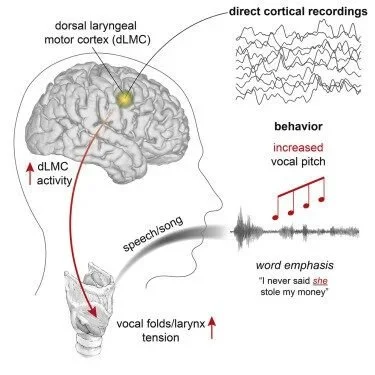
Credit to University of California, San Francisco. This diagram shows the laryngeal motor cortex responsible for speech control, including emphasis and pitch.
To begin, I’d like to focus on the control and development of vocalization and the laryngeal motor cortex (LMC). This region of the brain is responsible for the control of the vocal tracts and the larynx and is found in the inferior portion of the precentral gyrus of the human brain. However, when looking at the same area in the brains of monkeys and chimpanzees, scientists found that the laryngeal motor cortex was located more rostrally, and was proportionally smaller in size. This indicates that during the 50 million years ago after the humans and monkeys/chimpanzees split, the evolution of the humans allowed for a growth in the LMC and was placed further back in the brain of humans. More studies show that human LMC has direct connections to the nucleus ambiguus of the brainstem, so laryngeal motoneurons are directly modulated. The need for the LMC and motor areas involved in breathing and vocalization may have allowed for the convergence evolution of expiration, phonation, and articulation, creating better control of complex vocalizations. These reasons are likely to support the reasons why the LMC ended up evolving to be located more caudally in the human brain.
There exist transcription factors that promote the aspect of a developed vocal tract and LMC. FOXP2 was looked at to observe the effect it has on language, especially vocal tracts and sounds. It is also expressed in the laryngeal motor cortex. When a mutated gene was discovered in a gene-molecular study on subjects with speech difficulty, it was shown that a copy of a mutated FOXP2 gene caused verbal dyslexia, affecting three generations of one of the families. FOXP2 is expressed in many brain regions, but when looking at FOXP2 in many species, the defects or mutations in the FOXP2 genes lead to the failed imitation in birdsong, and in the case of mice, mice have pleiotropic defects as well as early death with the mutant FOXP2. Between mice and humans, there are only 3 amino acids related to language that humans have in which mice don’t, two of the three of them obtained after the split from chimpanzees. These two different amino acids were put in mice, and when they were observed, these mice had ultrasonic vocal patterns.
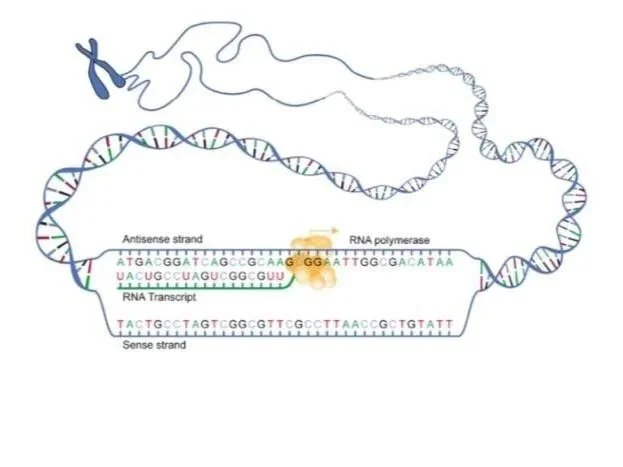
Credit to National Genome Research Institute. Transcription factors to the FOXP2 gene play an essential role in regulating our speech.
Following this, Neanderthals and Denisovans were also researched, and looking at their genomes, the scientists noticed that the two human-specific amino acids were also present in both relative in our sublineage. We can deduce that these changes must have occurred before the existence of Neanderthals, 400,000 - 800,000 years ago. This prompted more research on the more recent evolution of the vocal tracts and languages. Recently it was found that a fixed substitution in intro 8 of FOXP2, which affects a binding site for a protein-coding gene POU3F2 also contributes to the enhancement of the vocal tract and its ability to produce more complex sounds.
Let’s turn back and look at the mice with the mutant FOXP2 gene. It was shown that pleiotropic defects and early death were noted in the subject. Since these mutations in these organisms caused early death, early death indicates that FOXP2 plays an important part in biological fitness survival. The fitness and survival of the human species with the development of language not only provides communication for survival, but it also means that FOXP2 and POU3F2 play a part in the reproduction of humans by not allowing for early death by defective vocal tracts. Additionally, since the amino acids that affect these genes have been found in species similar to humans that have continued for at least hundreds of thousands of years and have only evolved into a more developed language system, this indicates that a positive impact on the biological fitness has been created in terms of the sense of reproduction. The larynx is essential to us in a wide range of vital behaviors, such as breathing, swallowing and voice production, all of which are necessary for our existence and communication.
As we are evolving, I believe that although humans already have the control of their vocalization to produce words and sound humans can understand, I believe that the LMC will not evolve much more. I believe that because our communication is already optimally suited for human lives, the evolution of speech and language is necessarily going to be needed to increase the biological fitness of humans. As languages are passed on from the previous generation, our abilities of language are based on the past of more recent centuries. As the most recent of new languages are from the 20th century, language has the potential to grow, but because humans have the natural tendency to stick with the familiar, I think that the evolution of language and the LMC will not change much.
Key Vocabulary
amino acids - organic compounds responsible for creating proteins
biological fitness - ability to survive, find a mate, and reproduce fertile offspring
caudal - behind
Denisovans - Denisova hominins, an extinct, ancient species of human (older than Neantherthals)
expiration - exhalation
intro 8 - a part of the FOXP2 gene
hierarchical syntax - the way sounds are organized into words to phrases to sentences, etc.
laryngeal motor cortex - the primary part of the brain responsible for speech and song production
larynx - the voice box that holds vocal cords in humans
mutation - a change in a gene
Neanderthals - homo neanderthalensis, an extinct, ancient species of human
phenotype - a physical characteristic (like color of hair or height)
pleiotropic - (describing a gene) affects multiple phenotypes
phonation - producing speech sounds
precentral gyrus - a part of the brain that is responsible for voluntary movement (like speaking)
Transcription - the way DNA is changed to RNA by proteins in cells
transcription factors - other nucleotides (structures of DNA) that affect the transcription of another gene - a specific sequence of nucleotides responsible for producing a certain protein or RNA sequence
verbal dyslexia - a learning disorder that involves difficulty in verbal communication
Sources Listed
-
https://www.sciencedirect.com/science/article/abs/pii/S0047248406000546?via%3Dihub
-
https://www.jstage.jst.go.jp/article/ast/33/4/33_E120401/_pdf
-
https://www.sciencedaily.com/releases/2018/06/180628151903.htm
-
https://www.researchgate.net/publication/322122086_The_Evolution_of_the_Frontal_Lobe_in_Humans
-
https://www.telc.net/en/about-telc/news/detail/the-worlds-newest-languages.html
-
https://brainconnection.brainhq.com/2017/09/03/the-evolution-of-language/
-
https://drive.google.com/file/d/1qdwMa8lkaCZU2UnAlJx5gQ7rsBS662a2/view
-
https://www.eva.mpg.de/documents/Chicago/Crockford_Comment_CurrAnthr_2015_2167182.pdf
-
https://www.the-scientist.com/features/why-human-speech-is-special--64351
-
https://www.ncbi.nlm.nih.gov/pmc/articles/PMC4230053/#!po=53.5714
-
https://www.ncbi.nlm.nih.gov/pmc/articles/PMC3983487/?report=reader
