
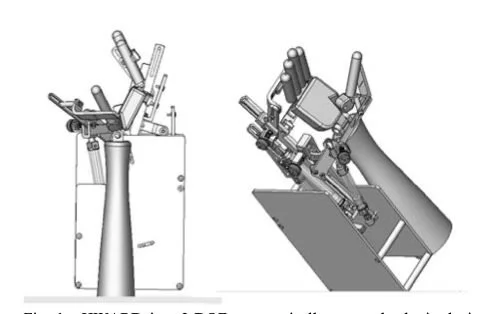
A group of researchers led by B.T. Volpe studies the impact sensorimotor training delivered by a robotic device in order to train and strengthen the upper limbs of those who have been paralyzed by a stroke. A group of fifty-six patients were tested, and half received standard stroke rehabilitation while the other half received robotic training. The group that received robotic training underwent at least twenty five hours. In order to measure the results, each patient was assessed through the Fugl-Meyer Motor Assessment, the Motor Status score, the Motor Power score, and Functional Independence Measurement. These measurements were performed on both groups.
Results and Discussion
The most important figures are the impairment scores measured before and after the treatment. The group that was trained with the robotic sensorimotor stimulation had an increased motor outcome for their shoulders and elbows. The robot group also resulted in greater functional outcome. The data shows that motor training improves motor performance of the shoulder and elbow. The new method may be beneficial to groups that have access to these resources and improve motor ability. However, this may not help groups that do not have as much access to medical resources. Robots can also malfunction, which may result in random errors and place patients’ lives in danger. This could be induced by factors such as electrical malfunctions or programming bugs.
Works Cited
Volpe, B. T., Krebs, H. I., Hogan, N., Edelstein OTR, L., Diels, C., & Aisen, M. (2000). A novel approach to stroke rehabilitation: robot-aided sensorimotor stimulation. Neurology, 54(10), 1938–1944. https://doi.org/10.1212/wnl.54.10.1938
