
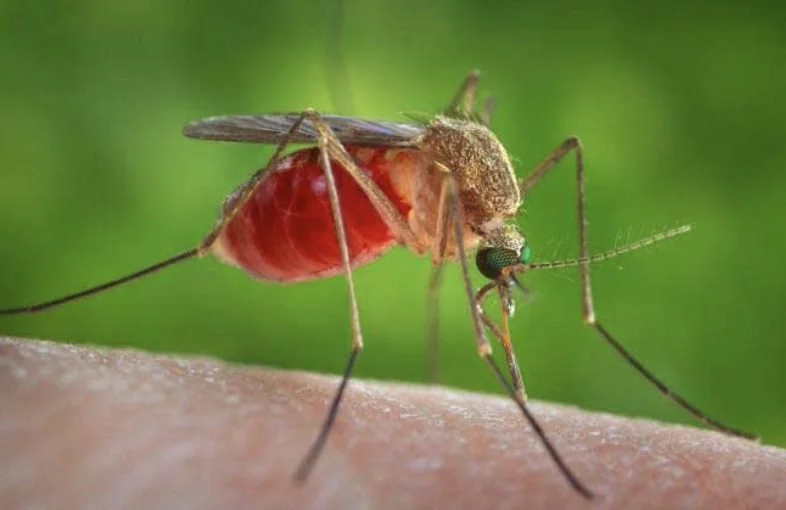
What’s the deadliest animal in the world? Is it a fearsome shark or a hungry bear? It turns out, the small mosquito is responsible for over a million deaths worldwide every year, compared to less than 200 shark encounters (AMCA, 2020; Naylor & Bowling, 2021).
When female mosquitoes bite humans, dogs, or even horses, they inject their saliva in order to receive blood. As a result of a foreign substance in the system, humans will release histamine, a signal chemical that tells immune cells to take care of the infection. This also results in irritation and the classic itchiness that we may feel when we get bitten (CDC, 2020).
But mosquitoes are not responsible for getting humans itchy. When infected by the parasite plasmodium, red blood cells will quickly begin to deteriorate. The red blood cell will begin to experience membrane invagination, which will collapse the membrane within itself, and phosphorylation (adding phosphate groups) to change the activity of the proteins on the surface of the cell (Mohandas & An, 2012).
For the next 48 hours, the parasite will live inside the cell’s vacuole, increasing and multiplying, digesting its hemoglobin protein. Using this protein, they derive a new one, called proteases, which will be used to rupture the cell from inside. They will also disrupt the cell’s ability to flow through the blood vessel, resulting in hemophilia, when the blood fails to clot (Mohandas & An, 2012). Finally, the parasite changes the MESA protein which is most responsible for binding to the cell membrane, resulting in destroying the cell. Post-infection, patients may experience shaking chills, headache, muscle aches, nausea, vomiting, jaundice, anemia, and tiredness, and without treatment, especially in developing countries, many are prone to death (CDC, 2021).
Malaria has contributed to over 400 million cases worldwide, and the problem has been recorded from as early as in Mesopotamia in clay tablets (IMCEAD, 2004). However, recent studies have shown that malaria vaccines have increased in efficiency. The biggest candidate is RTS,S/AS01. Variants of this vaccine have been deployed on mostly children, such as R21 which has up to 77% efficiency and Mosquirix, which has 56% effectiveness (Ledford, 2021). The main reason why these vaccines are so hard to cover is because the parasite itself constantly mutates within the cell, unlike the novel COVID-19 virus. As a result, many vaccines may be effective now, but there is still much work to be done.
Want to help? Learn more about malaria on the National Institute of Health or support Nothing But Nets, sponsored by the United Nations and the Melinda Gates Foundation, where you can help a fellow person get adequate mosquito nets and end their chances from being bitten.
Citations
Centers for Disease Control and Prevention. 2020. Mosquito Bite Symptoms and Treatment. Retrieved April 25th, 2021. https://www.cdc.gov/mosquitoes/mosquito-bites/symptoms.html.
Institute of Medicine (US) Committee on the Economics of Antimalarial Drugs; Arrow KJ, Panosian C, Gelband H, editors. Saving Lives, Buying Time: Economics of Malaria Drugs in an Age of Resistance. Washington (DC): National Academies Press (US); 2004. 5, A Brief History of Malaria. Available from: https://www.ncbi.nlm.nih.gov/books/NBK215638/
Ledford, H. 2021. Malaria vaccine shows promise — now come tougher trials. Retrieved April 25th, 2021. doi: https://doi.org/10.1038/d41586-021-01096-7
Mohandas, N., & An, X. (2012). Malaria and human red blood cells. Medical microbiology and immunology, 201(4), 593–598. https://doi.org/10.1007/s00430-012-0272-z
Naylor, G. & Bowling T. Florida Museum. 2021. Yearly Worldwide Shark Attack Summary. Retrieved April 25th, 2021. https://www.floridamuseum.ufl.edu/shark-attacks/yearly-worldwide-summary/.
The American Mosquito Control Association. 2020. Mosquito-Borne Diseases. Retrieved April 25th, 2021. https://www.mosquito.org/page/diseases.
Image credit to The Centers of Disease Control and Prevention.
