
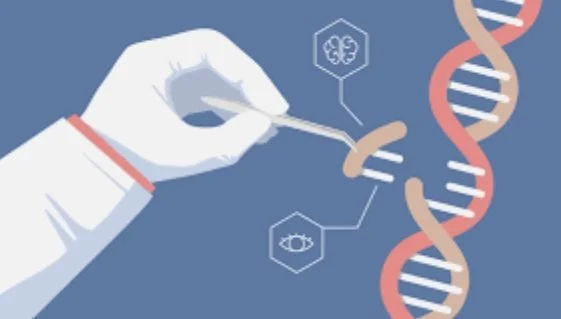
CRISPR stands for “clustered regularly interspaced palindromic repeats,” which are gene sequences in some prokaryotes that act as genomic records of previous viral attacks. Cas proteins are named because they are “CRISPR-associated” and they help track down these CRISPRs to cut them out. While CRISPR is one of the most famous gene-editing techniques, there are other techniques like TALENs and zinc-finger nucleases, but CRISPR has become more popular because it is less expensive and simpler to use.
The Cas9 enzyme (Cas9) is a bacterial endonuclease, or a protein that separates nucleotides from two ends. It will track two ends and then form a “double-strand break” to cut
The Cas9 protein can only recognize where it wants to cut using a guide RNA, which has 20-nucleotide sequences to match with the desired part of the DNA to cut. This matching sequence is called a protospacer.
The single guide RNA (sgRNA) is a piece of RNA that can be engineered with the desired protospace to cut a specific part of the DNA. The sgRNA is approximately 100 nucleotides long.
The scaffold region, or called transactivating CRISPR RNA or tracrRNA is a region that forms a scaffold, or a multi-hairpin loop structure, that binds to the Cas9 protein.
The protospacer adjacent motif (PAM) is a part of the sgRNA that separates the DNA strands that the sgRNA actually binds to, allowing Cas9 to cut the DNA.
