
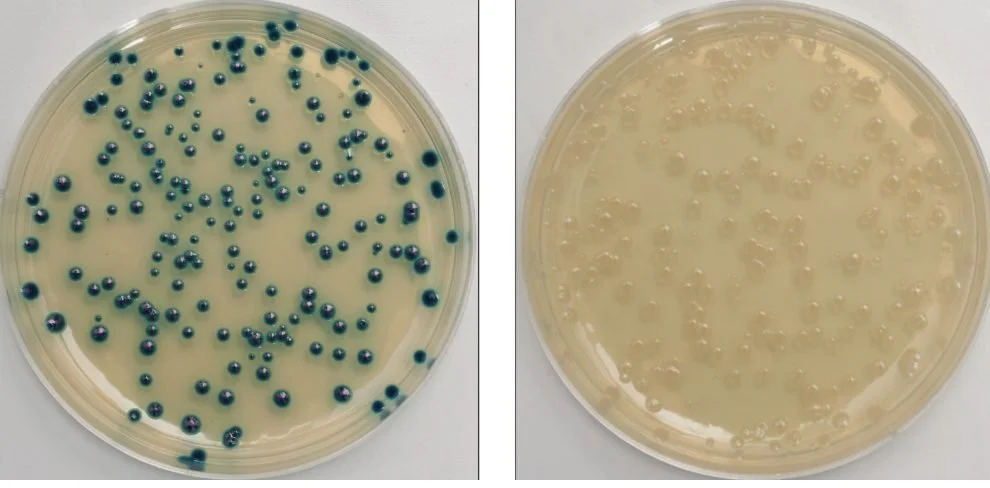
CRISPR has been a revolutionary technology for gene editing, but what actually is CRISPR? CRISPR Cas9 is actually a protein discovered in single-celled bacteria that were found in yogurt cultures, and it is an evolutionary technique that will cut off viral DNA that may infect it with.
In our lab, we have E. coli that has been genetically modified to have a gene that can express blue pigment, making our bacteria blue in the presence of a certain sugar, galactose.
Natural Cas9 has a single guide RNA (sgRNA) that is able to find a particular part of the genome to cut. CRISPR can now add (knock-in DNA) and make epigenetic changes to change what DNA gets expressed and transcribed.
The sgRNA will anneal to the double stranded DNA in a cell, and it will create a DNA double-strand break (DSB). After this, the cell will become stressed, because it senses that there has been a break in its DNA. As a result, the DNA starts a repair process. There are different types of repair methods, one of them called homology directed repair. A homologic DNA strand has a similar or identical sequence as the DNA that had been damaged. If there is a repair DNA around with this similar sequence, then the cell will take the repair DNA (called donor DNA) to “insert” DNA into the cell’s genome.
So there are 4 pairs:
-
Cas9 is a protein that is able to cut DNA.
-
sgRNA is RNA that recognizes parts of DNA that finds our specific DNA we want and allows Cas9 to cut it.
-
The cell wants to repair its cut lacZ locus, so it uses donor DNA to replace the DNA that had been cut.
-
The cell’s repair machinery will then replicate the donor DNA locus into the cut region, inserting a different gene that we want.
For our blue E. coli, the lacZ is the gene that is able to make the E. coli express blue pigment when it is able to digest galactose. When we use CRISPR, the Cas9 will locate the lacZ gene and will cut it. We add donor DNA that has similar genes surrounding the part that we had cut. However, in the middle of the gene, our donor DNA has a “stop signal,” so we can insert the stop signal to the lacZ gene.
Moreover, we can see how cells need repair machinery to repair themselves after Cas9 had cut their genes. Arabinose is a sugar that will help cells survive after we try CRISPR. Also, there are some bacteria that will have guide RNAs and other bacteria without RNA.
All of our E. coli will interact with Cas9, but it doesn’t necessarily mean that we will be able to actually genetically modify our bacteria. Here are our independent variables:
-
If we don’t have sgRNA, then CAS9 will not be able to find lacZ, so we expect we will still have blue E. coli.
-
If we don’t have arabinose, we don’t have enough repair machinery, and the cells will die after the Cas9 cuts the DNA.
