
Introduction
Dengue Fever is an infectious disease that can be fatal if serious. Recently, cases have been rising, with around 2.5 billion people at risk in tropical areas, where it is most commonly found. The risk of catching Dengue Fever is higher after rainy seasons, when mosquitos thrive the most. There are four main variants of Dengue Fever, which are all similar. If a person is infected with one of the variants, they are only immune to that particular variant and can still be infected with another variant in the future. If one gets Dengue Fever more than once, their risk of death increases.
Causes
Dengue Fever is a vector-borne disease, meaning that it spreads from one infected organism to another by another organism (vector). In this case, the vector is a mosquito, specifically the Aedes Aegypti mosquito—they are also responsible for spreading Zika virus and Yellow Fever. One most commonly catches Dengue Fever if one is bitten by a Aedes Aegypti mosquito that has dengue fever. Then, the fever moves into the bloodstream and causes an infection. Very rarely does it spread through blood transfusion, organ transplants or needlework.
Symptoms
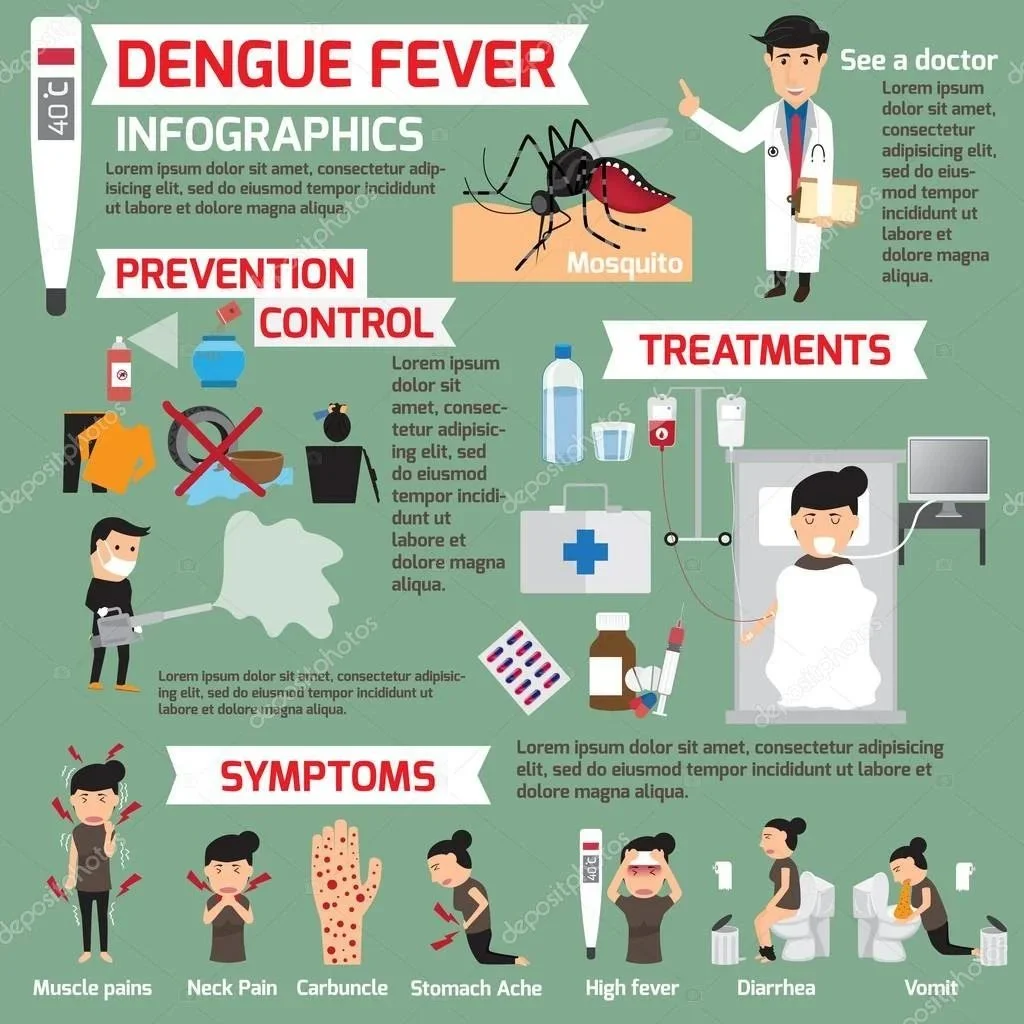
Common symptoms include: a high fever, nausea, muscle, bone or joint pain, vomiting, swollen glands, rashes, and pain behind the eyes. These symptoms are present for about a week, the average time for recovery. If these symptoms occur, it is best to call one’s doctor.
More severe cases of Dengue Fever are classified as Severe Dengue, Dengue Hemorrhagic Fever or Dengue Shock Syndrome. These cases can damage blood vessels and make them leaky, resulting in internal bleeding, shock, organ failure and death. Warning symptoms—which develop within one to two days after one’s fever goes away—include: severe stomach pain, vomiting, bleeding from gums or nose, fatigue, irritability or restlessness, difficult/rapid breathing, bleeding under skin (looks like bruises) or blood in urine, stools or vomit. If these symptoms occur, seek immediate medical attention.
Treatment
While there is no treatment for the virus itself, there are treatments available to help the symptoms. For example, if a person is experiencing joint pain, headaches, or dehydration, they can receive fluid therapy under the supervision of doctors.
Prevention
One way to prevent getting Dengue Fever is to get the vaccine known as Dengvaxia. It is most commonly administered in places where Dengue Fever is common. This vaccine however, is given to those who have a history of Dengue Fever, or have a blood test showing previous infection(s) with any of the dengue strains.
Another more common way to prevent getting Dengue Fever is to prevent mosquito bites. Some ways include staying in air-conditioned or well screened homes, wearing protective clothing, using mosquito repellent and reducing mosquito habitat (making it unsafe for mosquitos to thrive in the first place).
Case Study
According to a study done by the Pediatric Department of Maharaja Krishna Chandra Gajapati Medical College, around 84 of the 97 Dengue Fever cases in children were nonsevere, while the remaining 13 were severe. Gastrointestinal bleeding was common among those who had severe dengue fever. The most common age among the study was above 11 years. Children that often showed symptoms of fever, vomiting, pain and rashes—symptoms associated with hepatomegaly, or the enlargement of the liver—are more likely to have Dengue Fever.
Further Research
More research as to how to treat those who are experiencing Dengue Fever needs to be done. While there are clinical trials, most show that current therapies do not have a big effect on the recovery of those suffering from severe dengue cases. There should also be more research done on prevention of Dengue Fever.
Sources
Case study- dengue fever. Acasestudy.com. (2018, February 20). Retrieved July 9, 2022, from https://acasestudy.com/case-study-dengue-fever/
Rajapakse, S., Rodrigo, C., & Rajapakse, A. (2012). Treatment of dengue fever. Infection and drug resistance. Retrieved July 9, 2022, from https://www.ncbi.nlm.nih.gov/pmc/articles/PMC3411372/
Mishra, S., Ramanathan, R., & Agarwalla, S. K. (2016). Clinical profile of Dengue Fever in children: A study from Southern Odisha, India. Scientifica. Retrieved July 9, 2022, from https://www.ncbi.nlm.nih.gov/pmc/articles/PMC4860230/
Centers for Disease Control and Prevention. (2019, September 26). Transmission. Centers for Disease Control and Prevention. Retrieved July 9, 2022, from https://www.cdc.gov/dengue/transmission/index.html
Mayo Foundation for Medical Education and Research. (2020, November 18). Dengue fever. Mayo Clinic. Retrieved July 9, 2022, from https://www.mayoclinic.org/diseases-conditions/dengue-fever/symptoms-causes/syc-20353078
Image Source: https://globetotting.com/wp-content/uploads/2018/07/Dengue2.jpg
