
All humans and most animals experience some form of sleep. Although it is the activity that many of us spend the majority of our time in, many of the characteristics and functions of sleep remain undiscovered. Still, scientists are making great headway into the field of sleep and to fill this gaping hole in our scientific knowledge.
What is Sleep?
To many, it may seem that sleep is a set process–it is when one lies down and feels nothing except for the occasional dream. Still, we have to medically define sleep before we can delve into its functions. Sleep consists of a state of physiological characteristics including reduced body movement, limited electromyographic activity, closed eyes, limited responses to external stimuli, breathing at lower rates, and altered polysomnographic activity. For different animals, sleep consists of any combination of these characteristics, but all species share limited responses to external stimuli.
Sleep is a state in which one has limited interaction with their surroundings, so sleeping animals would be more likely to be attacked, gather less food, and mate, and it follows that sleep would be naturally selected against. However, it obviously did evolve for many species, for whom it is absolutely necessary, and scientists are beginning to understand the needs it satisfies.
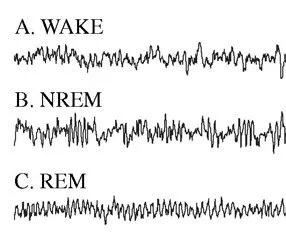
In humans, two types and five total stages of sleep have been measured. Non-rapid eye movement (NREM) sleep consists of stages I, II, III, and IV, with lower intensities of sleep measured by slower EEG waves and a regular breathing rate. Stage I sleep demonstrates EEG wave frequencies of 4-8 Hz, stage II sleep demonstrates oscillations of 10-15 Hz called sleep spindles, stage III sleep demonstrates slower frequencies of 2-4 Hz, and stage IV sleep has frequencies of 0.5-2 Hz. Rapid eye movement sleep, or REM sleep, has a variable breathing rate, with EEG waves similar to those of wakefulness, or 15-60 Hz.
Limiting Sleep
To examine the development of sleep, we can compare the sleep patterns of different species and the ecological determinants that may shape these patterns. Most terrestrial mammals experience some form of lessened EEG activity that ensures behavioral dormancy and reduces responses to stimuli. However, many marine mammals can experience a stage of sleep similar to NREM in humans that, instead of controlling the entire brain, alternates between the two hemispheres, providing rest while maintaining the ability to protect against predators, to float, and to traverse great distances. This form of sleep is called unihemispheric slow-wave sleep. While the ability to alternate between hemispheres is advantageous due to the constant partial wakefulness it provides, deeper ecological drivers explain the lack of REM sleep in marine mammals. Because REM sleep limits thermoregulatory control and causes muscle atonia, the need for these mammals to swim and maintain a body temperature higher than their cold environments most likely selected against REM sleep.
When in need, similar species can maintain wakefulness for long periods on end. For example, white-crowned sparrows sleep for less than 40% of normal when migrating, and bottlenose dolphins remain awake for up to five days to track prey through auditory means. For these species, the ability to completely suppress sleep may be necessary for survival in time-constrained situations, such as mating. However, these limitations on sleep only last for certain, short periods of an animal’s life. Therefore, such changes only have short-term benefits, and in the long-term, sleep has many more intrinsic benefits.
Evolutionary Advantages of Sleep
A proposed evolutionary advantage of sleep is that a protected period of inactivity is favorable to unnecessary nighttime wandering, which would increase the possibility of encountering predators. Supporters of this theory hypothesize that as animals developed this period of inactivity, all other current functions of sleep developed along with it, as they could be achieved in a devoted, concentrated time. However, critics argue that sleep becomes necessary and is naturally forced upon the individual by the body at some point, meaning that the period of relative inactivity developed instead as a result of the functions of sleep.
The duration of sleep has been found to decrease as the trophic position increases. This suggests that less sleep is a trait more selected for in herbivores and foragers than in carnivores, as foraging is a less energy-dependent and more time-consuming activity than hunting.
Next, studies have shown that when REM sleep is disrupted, the absorption of new information is limited, so REM sleep contributes to processing and storing memories. Percentage of REM sleep increases with brain mass, or amount of cognition. Therefore, animals that think more need more REM sleep, which supports this conjecture.
REM sleep can also be explained by the ontogenetic hypothesis, which states that REM sleep helps wire neural circuits in developing brains. One observation that supports this is that mammals engage in much higher portions of REM sleep when they are young than when they have matured, as younger mammals are still developing. For example, in humans, newborns experience 8 hours of REM sleep, while this number decreases to 2 hours at 20 years and 45 minutes in 70-year-olds. Also, mammals with higher gestation periods spend less time in REM sleep. Therefore, animals that have brains that have matured more in the womb need less time to develop neural circuits in REM sleep outside of the womb.
The functions of NREM sleep are less explored than those of REM sleep. In early studies, scientists found that time spent in NREM sleep increases along with overall body metabolism in mammals and that NREM sleep requires less energy relative to wakefulness and REM sleep. Therefore, it was hypothesized that NREM sleep helps conserve energy. However, newer studies have surfaced showing that NREM sleep decreases as body metabolism increases, although it still stands that brain metabolism is proportional to brain metabolism. In the future, more studies will undoubtedly shed more light on this particular function of NREM sleep.
Stage II NREM sleep differs from the other, low-frequency stages of NREM in that it is composed of high-frequency oscillations of 10-15 Hz called sleep spindles, which are a largely unexplained phenomenon. Due to their observational differences, stage II sleep is also believed to serve different functions than the rest of NREM. Studies show that increased sleep spindles are correlated with higher performance on IQ tests. Additionally, when subjects are exposed to high amounts of new information, sleep spindles drastically increase in amount and frequency. Both observations suggest that sleep spindles work to consolidate and retain memories.
While both birds and mammals possess NREM and REM forms of sleep, reptiles have long been thought to possess only a simple version of NREM sleep. Therefore, scientists thought that birds and mammals converged on these types of sleep separately, while their predecessors had limited forms of either. However, new studies show that reptiles also possess a form of REM sleep. If both types evolved together, it would mean that they are intrinsically linked and serve intertwined purposes.
Sleep still remains one of the most mysterious fields in science, but scientists are beginning to unravel the evolution and functions that define it. Once they do, a great gap in our scientific knowledge will be filled and many new doors will be opened.
Electromyographic activity – The activity recorded in electromyography, a medical technique where the electricity produced by the muscles is tracked and recorded.
Polysomnographic activity – The activity recorded in polysomnography, a method to monitor brain waves and eye and leg movements during sleep
Electroencephalogram/EEG – A device that measures the electrical signals produced by the brain
Trophic position – A measure of an organism’s position on the food chain.
Works Cited
https://www.ncbi.nlm.nih.gov/pmc/articles/PMC5390528/
https://www.sciencedirect.com/science/article/pii/S0960982216310132#tbl1
https://www.mayoclinic.org/tests-procedures/polysomnography/about/pac-20394877
https://www.ncbi.nlm.nih.gov/books/NBK10996/
https://www.sciencedirect.com/science/article/abs/pii/S0149763410002046
Image Credit: https://www.researchgate.net/figure/EEG-recordings-during-wakefulness-NREM-sleep-REM-sleep-and-after-pontine_fig6_10983970
Teens In Health Student Submission Winner
