
There is a silent reaper in our society. A force of nature that feasts in the shadows, with little whereabouts or responses to its rampage. A phantom that purges the citizens of countries abroad, unopposed and often to grim and depressing effect. This silent reaper is not a mass serial killer or a secret organization of assailants. Rather this reaper of despair is none other than antibiotic-resistant bacteria. Humanity’s greatest and oldest arch-nemesis.
An Analytical Overview of Antibiotic-Resistant Bacteria:
Antibiotic-resistant bacteria, henceforth deemed Superbugs, are defined by medicene.net as “ The ability of bacteria and other microorganisms to resist the effects of an antibiotic to which they were once sensitive”[1]. Currently, the CDC 2019 AR (antibiotic resistance) report [2] states that “ more than 2.8 million antibiotic-resistant infections occur in the U.S. each year, and more than 35,000 people die as a result. ”. In addition to this, antibiotic-resistant pathogen-associated hospital-acquired infections (HAIs), according to patientcarelink.org [4], cause over 99,000 deaths annually. Bring the total number of deaths caused by superbugs to be over 120,000 deaths annually, as well as tens of millions infected. Yet, researchers from the Washington University School of Medicine[6] estimated that the number of deaths caused by superbugs in U.S. hospitals has peaked at 153,113 recorded deaths in 2019. If this number is correct then antibiotic-resistant bacteria would be the 5th leading cause of death in the US, surpassing the 146,000 people who die from strokes[8]. The current number of infected cases and deaths associated with Superbugs is staggering. Though that is nothing compared to the grim future that antibiotic-resistant bacteria will bring.
According to analysts at Oxford University [7],“ In the coming future where the world might be left without any potent antimicrobial agent to treat (Antibiotic Resistant) bacterial infections. … As of the year 2050, about 444 million people would succumb to infections .” To put this number to scale, the number of people that would die from “Omni-resistant” superbugs in 2050 would be equivalent to the number of people currently living in the United States of America and Mexico combined [9]. This mere possibility alone is completely preposterous. Furthermore, superbugs already have a profound, negative impact on the state of our economy. According to an article titled, “Antibiotic Resistance: a Rundown of a Global Crisis.”[6]: “The total economic burden placed on the U.S. economy by antibiotic-resistant infections has been estimated to be as high as $20 billion in health care costs and $35 billion a year in lost productivity.” The economical burden of Superbugs will only continue to get worse as the number of infected cases and deaths associated with AR skyrockets. The impacts of which will not only be felt inside of the United States but also worldwide. If this comes to fruition, the world will be reverted from our modern-era to the pre-antibiotic times. A time of stagnant growth in both technology and economy.
Overall, antibiotic-resistant bacteria is not simply a problem that we can simply push down the road and hope for future generations to solve. Similar to the glaring catastrophe of global warming, standing idle is something that we simply are unable to afford. No amount of media or distractions will ever be able to cover up the millions of deaths in the future. 2050 is only thirty years away and current treatments for antibiotic-resistant bacteria are continuing to decline as the years stroll by. With each year that passes further deepening the hole that we must climb out of. But, antibiotics have served humans well for hundreds of years; so why now? What mistake did our society make to awaken the primordial beast?
The End to the Age of Antibodies:
In the past, bacteria were the greatest killers of mankind. The contaminated water and food that we drank and ate contained them, disposing of millions of people in the most grotesque way possible. Like an autonomous exterminator, they swept across the entire globe, erasing all that were unlucky enough to cross their path. This was the reality humanity suffered through, until the discovery of a cure-all substance by complete accident[11]. On one fine September day in 1928, Alexander Fleming noticed that a Petri dish containing the bacterium Staphylococcus had been contaminated by a strange mold. It turns out that this mold was a type of fungus, later coined Penicillium which produced Penicillin, an enzyme capable of lysing bacteria and preventing their growth. Thus, the first antibiotic was discovered, but even with the momentous occasion, many were still skeptical about the validity of Penicillin’s properties. Though, with time Penicillin would become an especially important drug that would be used to treat widespread infections of gonorrhea, pneumonia, and syphilis by both the allied and axis powers during World War II. With the introduction of new types of antibiotics and medicines, as well as rapid development in the salinity cities, the death rate and severe cases caused by bacteria dropped dramatically. Humans started using antibiotics for less and less serious symptoms of infections as well as overuse it in agriculture. According to Foodprint, 80 percent of all commercially sold antibiotics are used in factory farms to prevent the spread of pathogenic bacteria in livestock[12]. In other words, over 20 million pounds of antibiotic drugs are used in keeping livestock healthy in the US alone. To add insult to injury, a survey conducted by Kaiser Perminante[15]found that 45% of Americans believe that antibiotics can cure flu-like symptoms, and thus misuse prescription antibiotics that their doctors prescribe them. Furthermore, like waking up from a dream, humans forgot the terrible past that bacteria and infections caused. Instead, stereotyping bacteria as predominantly benign or even beneficial. We lost respect for both the enemy and the weapon.
Of course, bacteria are a stubborn species. Constantly evolving and multiplying to survive, a key example of natural selection at work. Once humans started using antibiotics, bacteria slowly but surely become ever more immune to our overused super weapons. This is further amplified by the arbitrary and unregulated usage of antibiotics in maintaining the health of billions of livestock used to feed the human race. Livestock is the origin of sixty percent of all diseases that plague humans[13]. The American Center for Science in the Public Interest linked 35 food-borne outbreaks from 1973 through 2009 of bacterial resistance to antibiotics to the food industry’s overuse of antimicrobial substances. By introducing these diseases to an onslaught of antibiotics we are essentially throwing fuel into the fire and cultivating more bacteria that are resistant to more and more of our antibodies. What was once a powerful tool that saved millions of lives is becoming nothing more than a small obstacle to the annihilation of the human race. By trying to defeat the enemy, mankind has only bred a more dangerous and potent poison with no “cure-all remedy” to combat it with. Now, the new generations of antibiotic-resistant bacteria are eager to finish what their ancestors had started. They are sweeping the globe with death rates exponentially rising every single year with no signs of slowing down, the BBC reporting by 2050 superbugs will kill more people than cancer [23]. The pre-antibiotic days of mass suffering may be coming back and fast, too. Unlike viruses and cancer, there has been very little funding and development in dealing with Superbugs, and any development we are seeing is recent and not suitable for commercial use yet. The WHO reported in 2017[14] that the world is running out of antibiotics to deal with antibody resistance, as well as that current research in discovering new antibodies is underfunded. We have all seen the catastrophic results of the Coronavirus or even the Spanish flu in our modern-day society. Imagine what a superbug with no known antimicrobial weakness and a high lethality rate can do.
A Remedy to the Returning Plague:
What can be done? Luckily there is a potential solution to this difficult problem. That being a new field of medicine in the form of phage therapy. Of course, to understand phage therapy, one must understand the commonly unknown and misunderstood phage.
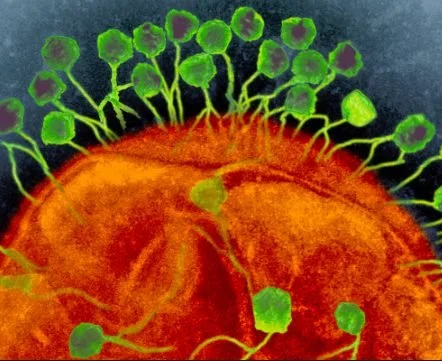
A phage, further referring to bacteriophage, is a simple yet elaborate looking organism. Almost spider-like in design with a head, body, and legs. Similar to its cousin, the virus, phages are not quite alive, but not quite dead either. Nothing more than genetic information contained in a capsule hoping by chance to infect a suitable host. Since the dawn of life bacteria and bacteriophages have been fighting an unending war leading to trillions of casualties on both sides of the front. Bacteriophages hijack bacteria to construct copies of their genetic information and synthesize new phages. They do this by binding to specific receptors on the host cell, puncturing the cell membrane, and injecting their genetic material into the cell. The genetic material is then read by the bacteria’s ribosomes and used to synthesize parts of the phage. The phage also modifies the bacteria’s RNA polymerase to begin producing bacteriophage RNA. Both processes disrupt normal cell function and are completely irreversible once they begin, effectively taking over the cell. Construction of new phages takes place within the cell with the assistance of helper proteins. Once a sufficient mass of phages is produced the cell will be forced to produce endolysin, a powerful enzyme that forms pores in a cell membrane, which starts puncturing holes in the cell, killing it and releasing phages into the environment to begin the cycle anew. This entire process of cell takeover to explosion takes around 15-16 minutes depending on the type of phages [17]. So, how does this relate to phage therapy?
Phage therapy is a medical practice that has been around for more than a century with the first documented clinical use of phage in 1919 at the Hôpital des Enfants-Malades in Paris where phages were successfully used to treat four pediatric cases of bacterial dysentery[22]. Phage therapy is defined as the therapeutic use of bacteriophages to treat pathogenic bacterial infections. While Phage therapy has been around for a long time, development, and funding into clinical trials to further research the subject has been strenuous at best. Though even with many ethical and financial hurdles, phage therapy is showing results. According to a report written by the NCBI[22], “In a hamster model of Clostridium Difficile (C. difficile)-induced ileocolitis, a single dose of phage concurrent with C. difficile administration was sufficient prophylaxis against infection; phage treatments post-infection saved 11 of 12 mice whereas control animals receiving C. difficile and clindamycin died within 96 hours”. This report clearly shows a correlation of phage therapy curing infection of bacteria in an organism. By far the most important application of phage therapy is to combating antibiotic-resistant bacteria. The reason for this is because phages infect and kill using mechanisms that differ from those of antibiotics, antibiotic-resistant mechanisms a bacterium may have are completely ineffective on phages [21] thus allowing phages to be used in combating antibiotic-resistant bacteria. Phages often outperform standard antibodies when dealing with bacterial infections because of their specific structures. Phages are extremely specific to the species of bacteria they can infect and thus pose no harm to any bacteria they are unable to bind to [19]. This is in contrast with antibodies that do not discriminate and kill all bacteria that are present in the area. Thus, phages would be much more effective in targeting a single strain of harmful bacteria for extermination while sparing the beneficial bacteria and preserving the delicate balance of the human microbiome. Phages are also inherently nontoxic because of their small size and their entire composition being that of nucleic acids and proteins [20]. Hence, the use of phages in humans should have little to no possible negative side effects.
Not only has phage therapy proven results in animals, but clinical trials involving phage therapy are also now proving the safety and efficacy of phage therapy use on humans. In 2007, Wright A1, Hawkins CH, Anggård EE, Harper DR. performed, quote [18], “A controlled clinical trial of a therapeutic bacteriophage preparation in chronic otitis due to antibiotic‐resistant Pseudomonas Aeruginosa; a preliminary report of efficacy” the results of which showed that, “The first controlled clinical trial of a therapeutic bacteriophage preparation showed efficacy and safety in chronic otitis because of chemo‐resistant P. Aeruginosa.”. The trial’s goal was to evaluate the efficacy and safety of a therapeutic bacteriophage preparation in targeting antibiotic-resistant Pseudomonas Aeruginosa in chronic Tititis. The experiment involved 24 patients with chronic Tititis being split randomly into two groups of 12. One group is treated with the strain of therapeutic bacteriophage preparation, while the other was treated with a placebo. The results of the experiment showed a significant reduction in Pseudomonas Aeruginosa in the group treated with phages compared to that of the control. If phage therapy can get sufficient clinical trials indicating its safety, then we may see widespread use of it to combat antibiotic-resistant bacteria in the future.
Yet like all good things, Phage Therapy comes with a few catches:
While all of the properties of phage therapy sound amazing, there are still some hurdles that must be overcome for phage therapy to become viable against treating superbugs. First, phage therapy is still quite limited in its application because all of the Phages used to treat pathogenic bacteria in clinical trials are found exclusively in natural environments [19]. While this problem may be solved in the future with more advanced genetic engineering techniques, currently it is extremely difficult to isolate a specific phage that can exterminate a specific bacterium. Any phage found in the wild must also be tested and identified for what strain of bacteria they infect. Thus, extreme precautions must be enforced when identifying strains that cause bacterial infection and their respective treatment phages, less we risk misidentification. This problem also leads to problems in the patenting and copying of phages. The phages used against a bacterium must be the same every single time it is created. Thus patenting of phages is nearly impossible, meaning that phage therapy may not be profitable enough for business ventures to invest in this technology. Aside from this, phage therapy also has a glaring problem in its safety and ethical morality. While IV phage therapy clinical trials have been given green light by the FDA in 2019, clinic and hospital use of phage therapy is at an extremely low point compared to the advancements made in our medical procedures. Another factor is the general arrogance of the public to the study of phage therapy and phages. Hence, there is little recognition of advancement made in this field as well as little funding in these clinical trials to date. So while phage therapy is indeed a powerful tool. It is still in its beginning stages and needs much, much more development and insight by both medical professionals as well as the common folk.
While vacationing in Egypt in November 2015, Tom Patterson, professor of psychiatry at UC San Diego School of Medicine, contracted a life-threatening infection with a multidrug-resistant strain of Acinetobacter baumannii. After suffering for many months in March of 2016, Patterson was transported to UC San Diego Health where, with emergency approval from the FDA, he was treated intravenously with an experimental phage cocktail that targeted A.Baumannii. Miraculously, he began improving almost immediately, emerging from a months-long coma caused by the bacterium. After a long recovery, Patterson became the first-ever person in the United States of America to receive successful intravenous phage treatment [15]. If it hadn’t been for the developments in phage therapy, Tom Patterson wouldn’t be here this very day and age. All around the world, some people were in the same condition that Tom Patterson was in, hopeless and helpless. For these people, we must all collectively agree to promote the development of phage therapy to fight superbugs. While it may be more attractive to find a cure for cancer or a solution to the world’s obesity epidemic. Antibiotic-resistant superbugs are slowly and dreadfully becoming a bigger and bigger problem that must be addressed to save our society. We can try to combat this plague by repeating the past and producing more types of antibodies, but eventually, we are going to run dry. If development into Phage Therapy is restricted and ignored further, our world will be plunged back into the pre-antibiotic dark ages. A time when children perished from a horrible disease that families could only witness take its course, helpless and hopeless. Let us take up arms against our nemesis of the past and finally dispose of them once and for all. Let us advance the field of phage therapy, for the good of everyone. To avenge our past, prolong our present, and save the future.
Bibliography and References:
Jr., William C. Shiel. “Definition of Antibiotic Resistance.” MedicineNet, MedicineNet, 4 Dec. 2018, www.medicinenet.com/script/main/art.asp?articlekey=2276.
“About Antibiotic Resistance.” Centers for Disease Control and Prevention, Centers for Disease Control and Prevention, 13 Mar. 2020, www.cdc.gov/drugresistance/about.html.
Jr., William C. Shiel. “Definition of Antibiotic Resistance.” MedicineNet, MedicineNet, 4 Dec. 2018, www.medicinenet.com/script/main/art.asp?articlekey=2276.
“Healthcare-Acquired Infections (HAIs).” PatientCareLink, patientcarelink.org/improving-patient-care/healthcare-acquired-infections-hais/.
Aslam, Bilal, et al. “Antibiotic Resistance: a Rundown of a Global Crisis.” Infection and Drug Resistance, Dove Medical Press, 10 Oct. 2018, www.ncbi.nlm.nih.gov/pmc/articles/PMC6188119/.
Knowles, Megan. “CDC Grossly Underestimating Superbug Death Toll, Researchers Find: Using a Method Different from the CDC's to Estimate the Burden of Antibiotic-Resistant Infections, Seattle Researchers Found a Significantly Higher Number of Deaths from Multidrug-Resistant Infections, According to CIDRAP News.” Becker's Hospital Review, www.beckershospitalreview.com/quality/cdc-grossly-underestimating-superbug-death-toll-researchers-find.html.
Spellberg, Brad, and David N Gilbert. “The Future of Antibiotics and Resistance: a Tribute to a Career of Leadership by John Bartlett.” Clinical Infectious Diseases: an Official Publication of the Infectious Diseases Society of America, Oxford University Press, 15 Sept. 2014, www.ncbi.nlm.nih.gov/pmc/articles/PMC4176319/.
“Biggest Threats and Data.” Centers for Disease Control and Prevention, Centers for Disease Control and Prevention, 13 Mar. 2020
www.cdc.gov/drugresistance/biggest-threats.html.“Countries in the World by Population (2020).” Worldometer, www.worldometers.info/world-population/population-by-country/.
Ventola, C Lee. “The Antibiotic Resistance Crisis: Part 1: Causes and Threats.” P & T: a Peer-Reviewed Journal for Formulary Management, MediMedia USA, Inc., Apr. 2015, www.ncbi.nlm.nih.gov/pmc/articles/PMC4378521/.
Healio. “Penicillin: An Accidental Discovery Changed the Course of Medicine.” Healio, 10 Aug. 2008, www.healio.com/endocrinology/news/print/endocrine-today/{15afd2a1-2084-4ca6-a4e6-7185f5c4cfb0}/penicillin-an-accidental-discovery-changed-the-course-of-medicine.
“Antibiotics in Our Food: What You Should Know.” FoodPrint, foodprint.org/issues/antibiotics-in-our-food-system/.
“Zoonotic Diseases.” Centers for Disease Control and Prevention, Centers for Disease Control and Prevention, 14 July 2017, www.cdc.gov/onehealth/basics/zoonotic-diseases.html.
“The World Is Running out of Antibiotics, WHO Report Confirms.” World Health Organization, World Health Organization, www.who.int/news-room/detail/20-09-2017-the-world-is-running-out-of-antibiotics-who-report-confirms.
“What Is Phage Therapy?” UC San Diego School of Medicine, medschool.ucsd.edu/som/medicine/divisions/idgph/research/center-innovative-phage-applications-and-therapeutics/patient-care/Pages/default.aspx.
Perry, Susan, et al. “Half of Americans Know Antibiotic Resistance Is a Health Threat, but Many Still Misuse the Drugs.” MinnPost, 25 June 2019, www.minnpost.com/second-opinion/2019/06/half-of-americans-know-antibiotic-resistance-is-a-health-threat-but-many-still-misuse-the-drugs/.
Aghaee, Bahar, et al. “Bacteriophage: A Solution to Our Antibiotics Problem? How We Can Us a Virus to Fight Bacterial Infection.” Science in the News, 2 Feb. 2018, sitn.hms.harvard.edu/flash/2018/bacteriophage-solution-antibiotics-problem/.
Wright, A., et al. “A Controlled Clinical Trial of a Therapeutic Bacteriophage Preparation in Chronic Otitis Due to Antibiotic‐Resistant Pseudomonas Aeruginosa; a Preliminary Report of Efficacy.” Wiley Online Library, John Wiley & Sons, Ltd, 23 July 2009, onlinelibrary.wiley.com/doi/full/10.1111/j.1749-4486.2009.01973.x.
Hyman, Paul, and Stephen T. Abedon. “Bacteriophage Host Range and Bacterial Resistance.” Advances in Applied Microbiology, Academic Press, 6 Mar. 2010, www.sciencedirect.com/science/article/pii/S0065216410700071.
Abedon ST, Thomas-Abedon C. Phage therapy pharmacology. Curr Pharm Biotechnol. 2010;11:28–47.
Górski A, Borysowski J, Międzybrodzki R, Weber-Dabrowska B. Bacteriophages in medicine. In: McGrath S, van Sinderen D, editors. Bacteriophage: Genetics and Microbiology. Norfolk, UK: Caister Academic Press; 2007. pp. 125–158.
Furfaro, Lucy L, et al. “Bacteriophage Therapy: Clinical Trials and Regulatory Hurdles.” Frontiers in Cellular and Infection Microbiology, Frontiers Media S.A., 23 Oct. 2018, www.ncbi.nlm.nih.gov/pmc/articles/PMC6205996/#B68.
Walsh, Fergus. “Superbugs to Kill 'More than Cancer' by 2050.” BBC News, BBC, 11 Dec. 2014, www.bbc.com/news/health-30416844.
Image Credit: https://health.ucsd.edu/news/releases/pages/2017-04-25-novel-phage-therapy-saves-patient-with-multidrug-resistant-bacterial-infection.aspx
Teens In Health Student Submission Winner
