
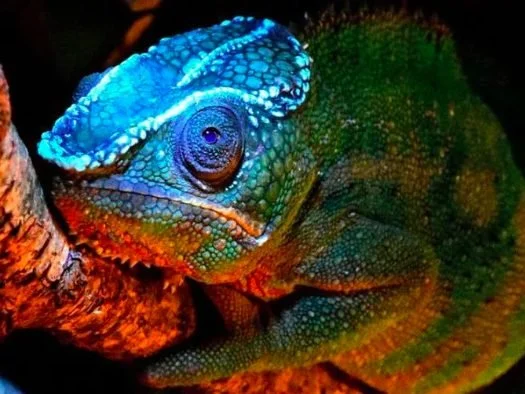
Chameleons have the ability to change their skin color for two purposes: one is to camouflage themselves in an environment and protect themselves from a predator, the second one is to stand out and attract potential mates. Scientists have been trying to replicate this process for a while and have finally developed a photonic crystal ‘smart skin’ that changes in the color spectrum in response to various factors such as the type of environment. This flexible smart skin reacts to heat and sunlight barely changing shape as the reaction occurs.
The coloration in organisms such as chameleons and neon tetra fish is the result of tiny particles called photonic crystals, not pigmentation as thought by popular belief. The repetitive pattern of these particles is the reason why light is reflected and shown. The visible colors change when there is a shift in the spacing between the particles. Even though the actual particles do not have a specific color, the spacing between them allows certain wavelengths to enter and keeps some out resulting in a specific color to be shown.
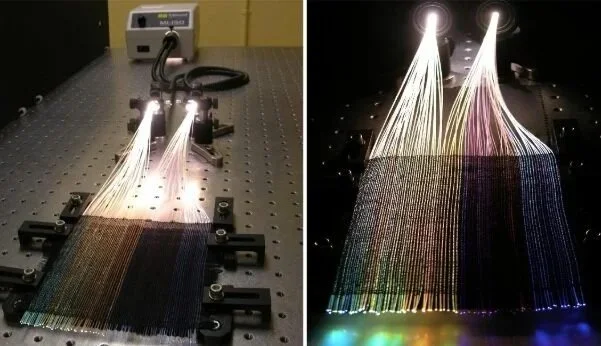
An Example of How Photonic Crystals Can Be Used
Through modern examples of structured coloring, the color of that of a strawberry remains the similar vibrant red as the pigments within the strawberry are the cause of their color. Alternatively, a more fragile and intricate object such as butterfly wings will become a dull powder as the photonic crystal array structures within the wing are destroyed as well, unable to refract the passing rays of light and lacking any prominent pigment.
As the variation of spacing within the crystal arrays, scientists have incorporated them within a more structurally stable and usable suit of water containing polymers, coined as hydrogels. The variation of appearance is the effect of the constriction and expansion of the hydrogels, which operates in function but applicability to humans is lacking in effectivity as the suit is forced to shrink or grow dramatically to correlate with the needed photonic crystal array pathways.
Through further observations of the character of a chameleon, researchers realized that the chameleon pattern overlays a dark matric upon a more expanded and distant array of photonic crystals. The distance of the patches of photonic arrays allowed for the chameleons to consistently change color without any change in the size of the chameleon itself. A theory had been drawn that the dark matrix and the photonic array operated complementary to the other in which the dark matrix compensates for the change in the structure of the photonic arrays.
To synthetically replicate the matter of reaction, the researchers embedded charged iron oxide crystals into the hydrogel segments and used magnetic forces to initiate and control the alterations. Additionally, to maintain the change evenly, the previous hydrogel suit designed by segments to allow for the total expansion and constriction of the suit, was now mechanically attached to one another to allow for space for only the expansion of the crystals. With this, the suit, now called the strain-accommodating smart suit (SASS), was able to retain relative size and change color.
Through the biological structure of the neon tetra and that of a simple leaf, the contact of the suit to direct sunlight alters the colors from orange to green, accurately mimicking the transformation of a chameleon. The developments made by researchers have provided insight into how a natural understanding of a creature’s adaptations can be implemented within the human lifespan. This smart skin highlights the importance of habitat adaptation that occurs almost daily in various environments and biomes.
“Chameleon Inspires 'Smart Skin' That Changes Color in the Sun.” ScienceDaily, ScienceDaily, 11 Sept. 2019, www.sciencedaily.com/releases/2019/09/190911083815.htm.
Image: “Photonic Crystal.” Photonic Crystal, emt-photoniccrystal.blogspot.com/.
