

Alzheimer’s is a disease with no cure that has researchers baffled as to why it occurs in the first place and the details behind that simple yet complex statement. After decades of focusing on Alzheimer’s research, a new idea and/or theory is proposed that is a factor that no one realized really affected the details behind the confusing disease that is Alzheimer’s. The factor that is introduced into the equation of figuring out more about the disease is a clue to what may go awry in the brains of those with Alzheimer’s. The clue is in the harmful rope-like structures that are called amyloid fibrils. Amyloid fibrils contain proteins that interlock in order to be sent through the brain, this being one of the reasons why Alzheimer’s plainly exists in people.
The small protein and peptide beta-amyloid also has a significant effect on the existence of this disease. There are two types of this protein: a normal one and an aged-damaged one. The normal one would help the amyloid fibrils function properly, but the aged-damaged peptide can be a very harmful factor. A specific version of the aged-damaged beta-amyloid contains a second molecular zipper that holds together various proteins, and this molecular zipper is something not previously found or researched. This raises many questions about the effect of this non-researched factor in Alzheimer’s disease.
Scientists were familiar with amyloid fibrils, interlocking- rope structures that coagulate in the brains of Alzheimer's patients, which have shown great promise to the reason and relation to the disease. As reported in a journal from 2005, the amyloid fibrils have interlocking properties through the reaction of myofilament bridges. With the protein inter-fixation discovered, the relation to degenerative diseases such as Alzheimer’s and Parkinson’s was theorized, and until recently has been elaborated upon with recent studies. Dementia, the primary and most prominent progressive brain disorder that gradually deconstructs neural pathways regarding memory, behavior, and human functionality.
Alzheimer’s is the prominent cause of dementia. Through the study of Rebeccah Warmack and her team at UCLA, a small protein (or peptide) beta-amyloid containing a second set of interlocking mechanisms, not recently recorded, which may be related to correlation to a second sub-functional form of standard dementia; less active and harmful than the initial, age-based disorder. As proteins operate in aqueous (water-enriched) environments for nourishment and effective transport of substances for functional and neural developmental purposes, water is completely pushed out of the protein when the proteins fibers interlock, there the issue is presented that once the fibers lock, they may not open again, causing a knot in the amino acid chain and peptide. As surrounding interlocal water molecules prevented the locking of the beta-amyloid, the utter lack of it internally lead to the opening of the fibers to be near impossible conventionally. The stuck fibers and the inter-lodged kink lead to the unending creation of beta-amyloid fibrils and this tumor is linked to the disease Alzheimer’s.
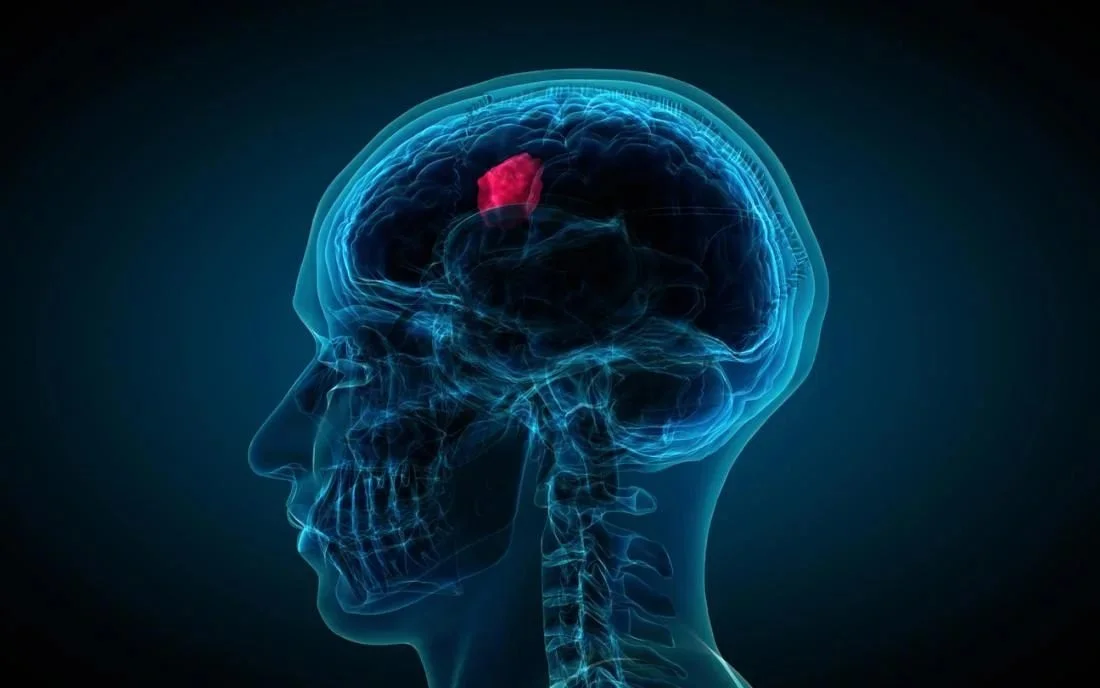
A tumor growing in the brain of a possible Alzheimer patient
As age was said to be a prominent factor in the development of Alzheimer's, the study effectively reflected that the repair enzyme loses its effectivity over time, and eventually may not match the rate of the creation of the jams around the age of 60. By this time, the minuscule tumor growth holds drastic influence and damage over the function of the brain. To add upon, beta-amyloid indirectly works with a much larger protein known as tau, which holds greater than 750 amino acids, to cause mass mental damage as the uncontrolled growth of the fibrils leads to the denature of the tau proteins, which can lead to be toxic and damaging to various other brain cells that currently may not have been taken in account. But as knowing is winning half the battle, the discovery of such kinks in the beta-amyloid structure allows researchers to target specifically to possibly rid the disease from its source.
The results from the research shed light on what other pharmaceutical companies can achieve in terms of preventing the production of the kink or a formula to make the re-pair enzyme function more efficiently. Researchers have found out that beta-amyloid has the potential to form tau clusters that would further spread the toxicity and damage neurons. The research done on how the brains of patients with Alzheimer's are affected by the thorough deterioration of neurons is an inspiration for further research and a better understanding of the disease. A later study had revealed the importance and effectiveness of cryo-electron microscopy, which allows scientists to see the exceptional features of larger biomolecules.
