

Intermolecular Forces
In our third unit of AP Chemistry, we discuss intermolecular forces and how they affect the interactions between molecules as gases and solids. We then use this knowledge to understand how different mixtures of molecules can interact with each other, introducing concentration (molarity) and spectroscopy (separating molecules by polarity).
We first start our unit with different types of intermolecular forces between other covalently, metallically, and ionically bonded molecules.
Note: All information in this unit can be found on Khan Academy’s AP Chemistry unit. This is simply a compilation of the unit into written summaries which can be used as an additional guidance for notes. For more information, please refer to their website.
London Dispersion Forces & Polarizability
London dispersion forces are random occurrences when two neutral atoms momentarily create dipoles (with a net charge of zero), attracting other neutral atoms, causing a domino effect of attraction.
London dispersion forces are proportional to the polarizability of a molecule, which relies on the size of the electron cloud.
IMPORTANT!
Generally speaking, the higher the molar mass, the more asymmetric, and the more electronegative a molecule is, the higher the London dispersion forces are.
London dispersion forces are proportional to the boiling point of a molecule. If there is a higher London dispersion force between the molecules, this means that there is a higher attraction between the molecules, and it takes more energy (more heat, increased boiling point) to cause the molecules to become gaseous.
Dipole-Dipole Forces & Hydrogen Bonds
Permanent dipoles are caused by polar molecules, either ions or molecules like water. Ion-dipole forces are forces between ions and polar molecules (not necessarily ionic bonds), and dipole-dipole forces are forces between two polar molecules. The attraction between two polar molecules are dipole-dipole forces. Dipole-induced forces can happen as London dispersion forces as well as ions inducing neutral molecules to momentarily be attracted to them.
Hydrogen bonds, a type of dipole-dipole force, are bonds between molecules with hydrogen atoms attracted to more electronegative atoms. In these molecules, there is a permanent dipole with a slight positive charge where the hydrogen atoms are and a slight negative charge where the central atom is.
IMPORTANT!
Since they are permanent dipoles, hydrogen bonds between other polar molecules are stronger than London dispersion forces.
Vapor Pressure
Vapor pressure is the measure of kinetic energy of gaseous molecules at a particular temperature.
In a closed system at a temperature lower than a molecule’s boiling point, some molecules may still momentarily be released from the intermolecular forces as gases. Similarly, these gas molecules can also bound around and momentarily be attracted again to these intermolecular forces, becoming liquids again.
IMPORTANT!
When a molecule has a greater boiling point, this means that the vapor pressure will be less than the molecule with a lower boiling point at the same temperature. This is because although the molecules may both be randomly becoming gases, the one with a lower boiling point will have more molecules becoming gases, resulting in greater kinetic energy.
Ionic Solids
IMPORTANT!
Ions have high melting points because their cations and anions interact through strong intermolecular forces, not the molecules themselves.
The melting point is dependent on how strong intermolecular forces are between atoms in a molecule, which is dependent on the charges and the size of the molecule. Ionic solids are brittle because once you move them a little bit, some cations line up with other cations and anions to anions, forcing them to break. In solid form, electrons like the way they are, so they do not conduct electricity well. However, in liquid form, ions are able to conduct electricity well since their electrons can move easily.
Metallic Solids
In alkali metals and transition metals, they usually have only one or a few valence electrons, so they either will form ionic bonds or metallic bonds with themselves. With pure metals, they form a sea of electrons, so they can conduct electricity well. Since they are in a sea of electrons, metals are very malleable to move the cations around.
Molecular Solids
In reactive nonmetals, these molecules can form covalent bonds with each other. These usually do not form ions, so they are relatively bad at conducting electricity. They also have a relatively low melting point since the dispersion forces are relatively low.
Covalent Network Solids
Covalent network solids are not exactly molecules because they are continuous atoms covalently bonded to each other, meaning they are very hard to melt, and they are not great conductors of electricity.
Crystalline versus Amorphous Solids & Polymers
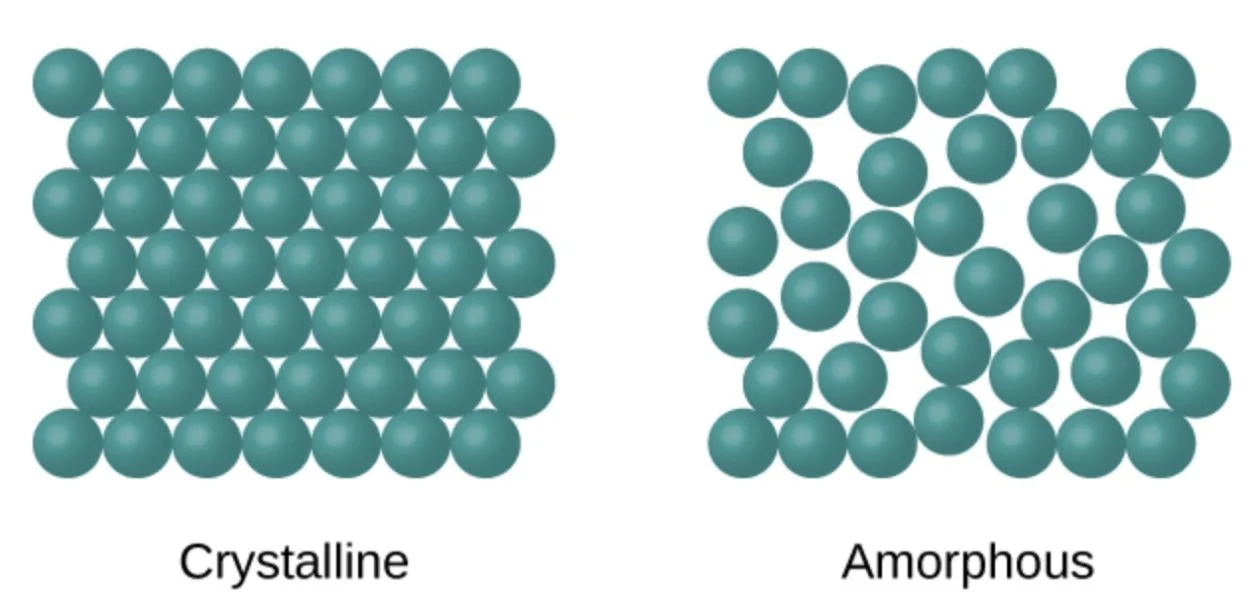
Image from https://opentextbc.ca/chemistry/chapter/10-5-the-solid-state-of-matter/
Crystalline solids have a very fixed and orderly arrangement while amorphous solids have more flexible, stretchy arrangement, such as in rubber.
Rubber is made of amorphous polymers. Polymers are molecules formed by repeating units.
Effusion
Effusion is the rate at which a gas will escape from microscopic pores in a closed container. This can be calculated using the speed of the gas particles, so effusion is proportional to the temperature (causing the gas particles to speed up and try to bump out) as well as the pressure.
Ideal Gas Law
IMPORTANT!
Volume is inversely proportional to pressure because as we decrease volume, we increase pressure.
We know that volume is proportional to temperature because as temperature decreases, volume decreases.
Volume is inversely proportional to the molar mass. The greater the volume, the fewer moles we need to get 6 x 10^22 atoms.
In a mixture of gases, the total pressure is the sum of the partial pressures, which is proportional to the molar fractions of gases. Note! Always round to the fewest number of significant digits!
PV = nRT
Kinetic Molecular Theory
In an ideal gas, we assume 3 things:
-
The molecules take up negligible space relative to total volume.
-
All molecules do not interact with each other.
-
All collisions are elastic, meaning that temperature is consistent.
Boyle’s Law
Pressure is inversely proportional to volume.
Gay-Lussac's Law
Pressure is proportional to temperature.
Charles’ Law
Volume and temperature are inversely proportional.
Avogadro’s Law
The number of particles is inversely proportional to volume.
Dalton’s Law
Total pressure is the sum of all partial pressures.
Maxwell-Boltzmann’s Distribution states the distribution of the number of molecules that are travelling at a particular speed at room temperature, where the peak is introduced as the most probable speed of the average molecule in a closed system.
Real Gases
In real-case scenarios, the values that we use when solving the Ideal Gas Equation are slightly different.
-
Volume Assumption: When there is a very small volume, then the molecules take a significant amount of the total volume, so pressure increases.
-
Interaction Assumption: When the temperature is low enough to the condensation point or high enough to the boiling point, then the pressure either increases or decreases, depending whether or not we become more interactive (gas) or less interactive (solid).
-
Average Temperature Assumption
IMPORTANT!
Real gases are more likely to obey the ideal gas equation at higher temperatures, meaning they are going too fast to be affected by intermolecular forces, and at low pressures, meaning that they occupy less space inside the total volume, and their volumes become insignificant from the total.
Types of Mixtures
We have heterogeneous (not macroscopically uniform) mixtures and homogeneous mixtures, or solutions. Aqueous solutions have water as its solvent, like salt water, although salt water is not microscopically homogeneous. Solubility is the measure of how easy it is for a solute to dissolve into a solvent. The more polar a solute is, the easier it is to dissolve in another polar solvent.
IMPORTANT!
For solubility of a solute, this is different from the polarity of the individual molecules. For alcohol molecules, it is true that longer alcohol chains will have individual greater dipoles. However, the density of alcohol, the concentration of alcohol, decreases as size increases. Meaning, although individual molecules are more polar, the solute is less polar.
Distillation
In order to separate a solute from a solvent in a solution, we can take advantage that the chemicals may have different boiling points from each other. As a result, we can boil the solution to its boiling point, but since its constituents have different boiling points, the solute that has the lower boiling point will start boiling and evaporating faster, which we can condense and separate as a separate liquid in another solution. This is called simple distillation.
If we want to have an even more sophisticated method, we can condense and evaporate for a lot of cycles, so the probability that we are vaporizing is the one with a lower boiling point. This is more effective, and it is called fractional distillation.
Thin Layer & Column Chromatography
Thin layer chromatography is a method used to separate polar molecules from less polar molecules in a solution.
There is the stationary phase, usually silica gel, which is a very polar and porous substance, which we drip the solution onto. We also have a mobile phase, which is a less polar substance than our target substance, which we use to compare how polar something is.
Then, we put the silica gel onto the less polar solvent. The more polar molecules in the original solution will be more easily moved inside the porous substance while the more polar molecules will likely stay put.
We can measure the retention, or retardation, factor by dividing the distance traveled by the solute, which is more polar, from the origin by the distance traveled by the solvnet, which is less polar.
Column chromatography is similar in that we have our stationary phase, this time inside a column, and we have our solute on the top and mobile phase on top of it. The solvent will move down with gravity, down the column, along with the less polar solutes while the more polar solutes will move less.
Spectroscopy
How does light interact with other molecules? In order to see how shooting photon rays can affect molecules, the University of Colorado, Boulder has an online simulation for how spectroscopy works.
Microwave radiation causes molecules to rotate, infrared radiation causes molecules to vibrate, visible light causes molecules to excite and reemit, and ultraviolet radiation breaks covalent bonds.
Electronic Transitions
Electron transitions usually happen under visible and ultraviolet radiation and light.
IMPORTANT!
Given that the first ionization energy is 5.78 * 10^5 J/mol, we need to first know the energy in Joules per Atom.
There are 6.022 * 10^23 atoms in a mole, so we have 9.60 * 10^-19 Joules per atom of aluminum.
Now, we have our frequency is equal to speed of light divided by the wavelength, so we can find Energy = Planck’s constant * speed of light / wavelength.
Spectrophotometry
When we shine light through a less concentrated solution, it will emit more light than if we shine it through a more concentrated solution since there would be more molecules to absorb the light. If we shine it through a longer period, it will emit even less light afterward since there are more opportunities for the molecules to absorb more light.
As a result, we can calculate the concentration of a solution by shining light through it.
Transmittance is the measure of how much light is able to pass through a solution, and it is measured as the resulting amount of light after it has passed through the solution over the initial amount of light.
Absorbance is the measure of how much light had been absorbed by the solution, and it is measured by the negative logarithm of the resulting amount of light over the initial amount of light.
By the Beer-Lambert Law, we discover that the absorbance is proportional to the concentration of a solution, which we measure as:
A = mc + b.
Usually, scientists are able to find the concentration of a solution by graphing experimental data gathered, apply linear regression onto the graph, and then find the concentration using the known values.
The energy to move an electron to a different electron shell while orbiting an atom is equal to the energy of a photon emitted when that electron moves shells. By Planck’s equation, we are able to convert the energy of a photon using its frequency, or
E = hv
We can also calculate the speed of light using the wavelength and frequency of the photon. Knowing this, we can calculate the energy of a photon by knowing its wavelength.
