

Molecular Structures and Bonds
In this unit, we learn about different interactions between atoms depending on their individual characteristics. We learn about ionic, covalent, and metallic bonds, how to represent them, and how there are different ways to learn more about molecules’ shapes, polarities, and chemical bonds.
Note: All information in this unit can be found on Khan Academy’s AP Chemistry unit. This is simply a compilation of the unit into written summaries which can be used as an additional guidance for notes. For more information, please refer to their website.
Ionic, Covalent, and Metallic Bonds
Ionic bonds are bonds between very electronegative atoms and atoms with very low ionization energy, such as sodium chloride, where sodium loses an electron (having a new positive charge) and chlorine loses an electron (having a net negative charge). Since they have non-zero charges, ionic bonds make their resulting ions stick rigidly to one another.
Covalent bonds are bonds between atoms where they share their electrons. Some atoms are more electronegative than their constituent atoms, such as oxygen in water, which forms polar covalent bonds. We denote these bonds using delta to show the net positive and negative charges on either parts of the molecule.
Metallic bonds give metals their unique properties. Metals, like iron, are elements that bond without very fixed connections, unlike how ionic bonds seem to “stick” ions together or how covalent bonds pair up to share electrons. Metallic bonds, on the other hand, have their electrons flowing between them, and these atoms group together. This makes metals able to conduct electricity very easily as well as very bendable and malleable. Metallic bonds are usually formed with atoms with low electronegativity, meaning they don’t hog electrons, letting electrons pass through easily and conducting electricity.
Metals, Nonmetals, and Metalloids
Metals are elements that are shiny, malleable, good conductors of heat and electricity. They are usually solid at room temperature.
Nonmetals are elements that appear dull, poor conductors of heat and electricity. They are usually gaseous at room temperature.
Metalloids are elements that conduct heat and electricity moderately well, and possess some properties of metals and some properties of nonmetals.
Main-group elements (or representative elements) in the columns labeled 1, 2, and 13–18, excluding hydrogen
Examples: helium, lithium, beryllium, boron, carbon, nitrogen, oxygen, and fluorine
Chemically, they are the most abundant elements in the universe.
Transition metals in the columns labeled 3–12
Examples: iron, manganese, chromium, and copper.
Chemically, they are defined with having two valence shells instead of one
Have a strong tendency to form coordination compounds, and many of their compounds are colored.
Inner transition metals in the two rows at the bottom of the table (the top-row elements are called lanthanides and the bottom-row elements are actinides; Figure 3).
Elements in the first group (except hydrogen) are known as alkali metals, and they all have similar chemical properties.
The elements in group 2 (the second column) form compounds consisting of one atom of the element and two atoms of hydrogen: These are called alkaline earth metals, with similar properties among members of that group. Other groups with specific names are the pnictogens (group 15), chalcogens (group 16), halogens (group 17), and the noble gases (group 18, also known as inert gases). The groups can also be referred to by the first element of the group: For example, the chalcogens can be called the oxygen group or oxygen family. Hydrogen is a unique, nonmetallic element with properties similar to both group 1A and group 7A elements. For that reason, hydrogen may be shown at the top of both groups, or by itself.
Metals will form metallic bonds with other metals. Metals will form ionic bonds with non-metals. Non-metals will form covalent bonds with other non-metals.
Bond Length & Bond Energy
Hydrogen can form covalent bonds with other hydrogen atoms to form diatomic molecules. H2 usually share their electrons with their nucleus 72 picometers apart. If we try to pry these atoms apart, we need 432 kilojoules per mole of hydrogen atoms in order to pry them apart. As we pull atoms apart, they gain potential energy like a spring would if you stretch it, until finally, we pull them apart (zero potential energy). Similarly, if we try to push atoms together, we gain potential energy like how we push a spring together.
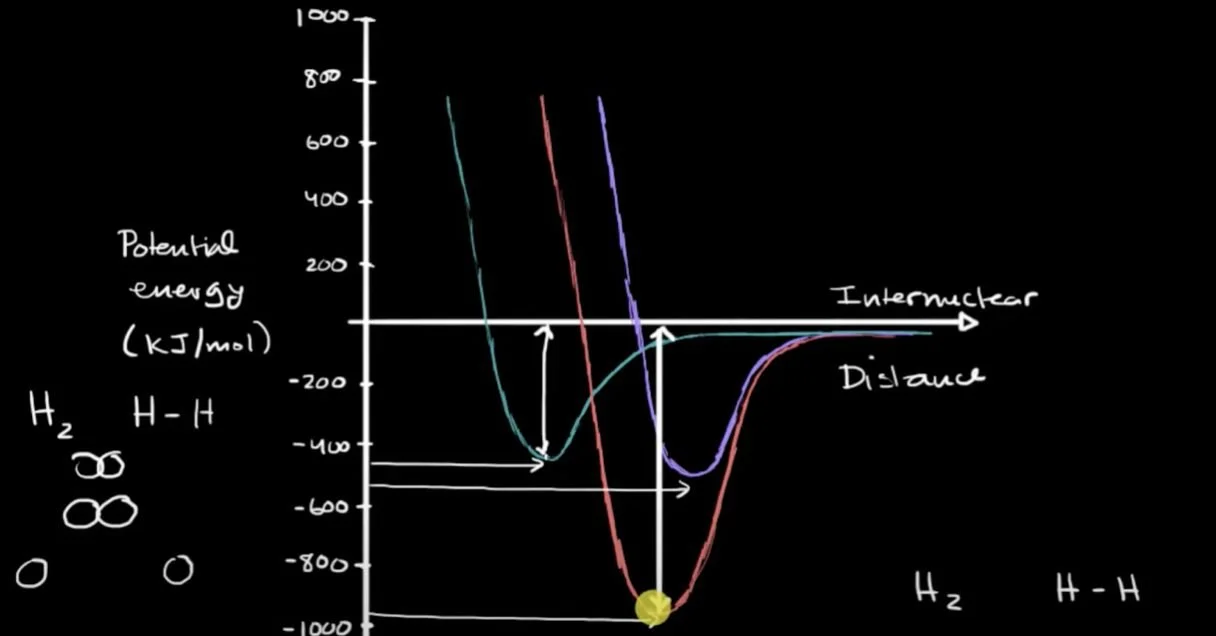
Although nitrogen has a bigger radius than oxygen, nitrogen has a triple covalent bond in N2, compared to the double bond in O2. Meaning, the bond energy is much greater for N2 than O2.
Ions tend to form lattice structures because they are able to stick together in a crystalline shape, such as NaCl.
In a particulate model (a model of a two-dimensional slice of a 3-dimensional configuration), anions and cations align with each other and they avoid their like ions to form a lattice structure.
Lattice energy is the energy it takes to break an ionic bond. This is similar to bonding energy, except bonding energy deals with covalent bonds. The greater the magnitude of the net charge, the higher the lattice energy. The smaller the molecule, the greater the lattice energy. Cations get smaller when they lose an electron, meaning their protons attract the remaining electrons even more, while anions get larger when they gain an electron because there are more electrons repelling each other. The net charge resulting is part of the force that pulls the ions together, while the radii of these ions determine how much this force is. The greater the force, the greater lattice energy needed.
Alloys are mixtures of metals that have metallic properties with many metallic bonds (due to low electronegativity, they just share electrons, being conductive). For example, steel is an alloy created by iron and carbon. Since iron has 26 protons, while carbon only has 6 protons, iron is much larger than carbon atoms, so the metal formed has carbon atoms that fill gaps between other iron atoms. This makes steel an interstitial alloy. In other alloys such as brass, made up of copper (atomic number 29) and zinc (atomic number 30), are substitutional alloys because their metals are roughly the same size. Finally, alloys that are both interstitial and substitutional have both, such as stainless steel with chromium (similar size to iron) and carbon (smaller than iron).
Lewis Diagrams
IMPORTANT!
How to Create Lewis Diagram for CH2O (formaldehyde):
-
Find the total number of valence electrons.
-
Carbon has 4 valence electrons, hydrogen has 1 valence electron, oxygen has 6 valence electrons.
-
In total, we have 4 + 2 + 6 = 12 valence electrons.
-
-
We find the central atom.
-
The central atom is usually the atom with the lowest subscript in the molecular formula and the atom that can form the most bonds (i.e. fewest valence electrons). If all of the atoms usually form the same number of bonds, the least electronegative atom is usually the central atom.
-
Must be least electronegative not hydrogen, so carbon.
-
-
We fill the most electronegative atom first with our total number of valence electrons, then we try to fill the octet rule, forming different covalent bonds (each bond gives 2 valence electrons to each).
-
Show electric charge on a completed molecule.
Octet Rule Exceptions
IMPORTANT!
Be careful of hydrogen, boron, aluminum, and any element with atomic number more than 19 (past period 3). They DO NOT need to fulfill the octet rule.
Formal Charge & Resonance
Resonance is the state when there are different ways to draw a molecule’s lewis structure to fulfill the octet rule. Many times, we use the lewis structure that fits rules regarding formal charge, to try and make it as close to 0 as possible.
Formal charge is defined as the valence electrons of an atom in a molecule minus the electrons around it, which is the number of lone electrons and the number of electron pairs of an atom in a molecule.
IMPORTANT!
To determine what resonance structure contributes most to the resonance hybrid:
-
Individual atoms have formal charge as close to 0 as possible.
-
Any negative formal charge is on the most electronegative atom.
To determine the bond order, add all the single bonds (1) and double ones (2) and divide by the number of resonance structures. This gives you an idea of comparing bond lengths and resonance structures.
The greater the bond order, the bond is stronger, and thus is shorter.
VSEPR (Valence Shell Electron Pair Repulsion)
The Valence Shell Electron Pair Repulsion (VSEPR) theory guides us using our drawings of three-dimensional representations of molecules by showing us their electron cloud geometry and their molecular geometry.
IMPORTANT!
NOTE: Lone Electron Pairs, in order to maximize repulsion, are placed on the equatorial plane.
-
To determine electron cloud geometry, find the number of electron pairings around the central atom (linear, trigonal planar, tetrahedral, trigonal bipyramidal, octahedral).
-
To determine molecular geometry, find the number of electron pairings, ignoring lone pairings.
VSEPR for 2 Electron Clouds
-
Linear
-
Bond Length: 180 degrees
-
-
Bent/Angle Shape
-
Bond Length: The angle of bent molecules is less than 120 if there is one pair of nonbonding electrons and is less than 109.5 if there are two pairs of nonbonding electrons.
-
VSEPR for 3 Electron Clouds
-
Trigonal Planar
-
Bond Length: 120 degrees
-
VSEPR for 4 Electron Clouds
-
Tetrahedral
-
Bond Length: 109.5 degrees
-
VSEPR for 5 Electron Clouds
-
Trigonal Bipyramidal
-
Bond Length: 120, 90 degrees
-
VSEPR for 6 Electron Clouds
-
Octahedral
-
Bond Length: 90 degrees
-
Irregular Shapes:
-
T-shape
-
See-saw shape
-
Trigonal Pyramidal
-
Square Pyramidal
-
Square Planar
Bond Hybridization
The steric number is the number of atoms, groups, and lone pairs around a central atom.
SP3 Hybridization
-
4 SP3 Hybrid Orbitals
-
25% S-orbital, 75% P-orbital
-
Greatest Bond Length because least electron density
SP2 Hybridization
-
3 SP2 Hybrid Orbitals, 1 P-orbital
-
33% S-orbital, 67% P-orbital
SP Hybridization
-
2 SP Hybrid Orbitals, 2 P-orbitals
-
50% S-orbital, 50% P-orbital
-
Smallest Bond Length because greatest share of S-orbital
