
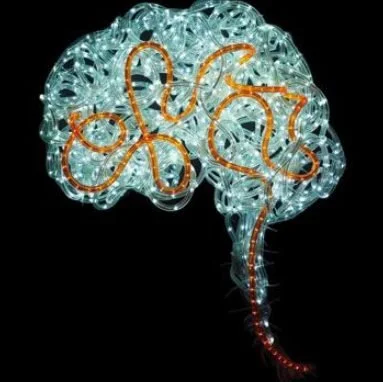
Lights and colors comprise our surroundings, creating details, and many of the aspects of the world we live in. To take these colored lights to the next step, scientists questioned whether these brilliant lights and colors could be harnessed to possibly control or impact nerve cell activity. Apparently, this can be done.
Light pulses have been utilized in activating nerve cells in monkeys’ brains. Of course, this research is far from complete due to its early stages of experimentation, but scientists are hopeful that this research will be useful in someday treating illnesses that have to do with the inactivity/abnormal behavior of human nerve cells.
The process of controlling the reactions of the nerve cell through light is referred to as optogenetics. In order to conduct this method, one needs to place “thin optical fibers” in the brain (ScienceNews, 2019). Of course, a procedure like this involves a variety of risks ranging from inflammation and infection to tissue damage. Any operation with the brain is generally one of many possible risks. Without a doubt, there would be several ethical concerns about this method.
Study coauthor Diego Mendoza-Halliday of MIT led a team of researchers to create a light-responsive molecule that actively detects dim light. This molecule, named SOUL, was injected into monkey’s brains. They shone blue lights through the monkey’s skull, which resulted in the activation of the SOUL molecules. They have already been successful with SOUL being able to sense light coming from the skull in mice, but not yet for monkeys.
This has been the first time that this has been done in the scientific community, and these findings are only the basis for what future experiments on humans will be. Working with monkeys and rats is the first step to figuring out the background of brain diseases in humans.
Having a sort of LED light system implanted in human brains may be able to treat and help further gain importance on brain diseases. In the future, these types of light systems might be able to turn off and fix brain cells so epileptic seizures and other brain diseases can be treated.
Work Cited: https://www.sciencenews.org/article/light-outside-skull-can-turn-nerve-cells-monkey-brains
Image Credit: https://i.pinimg.com/originals/60/fd/25/60fd2518103f8f01cfdae68b0c606404.jpg
