
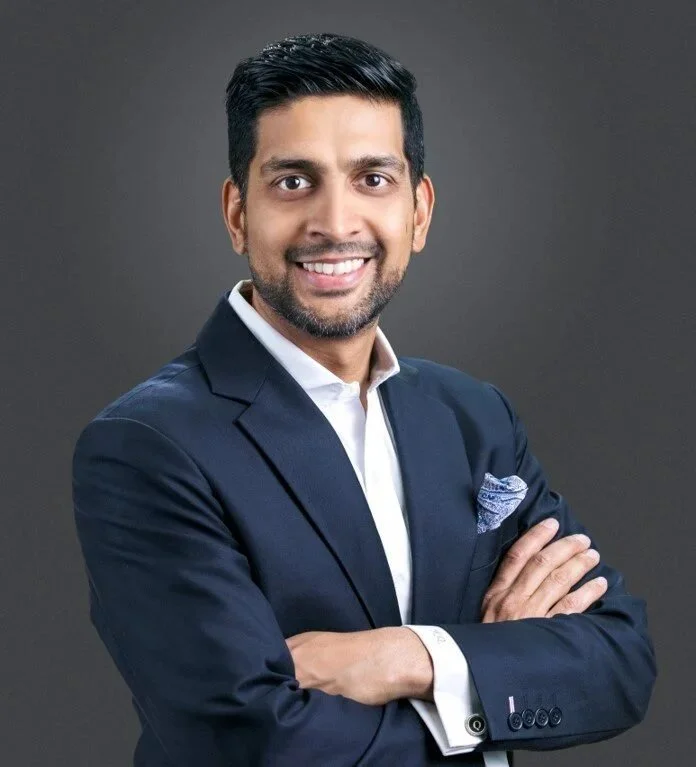
An Interview with Kashef Qaadri
“There is still so much to learn as I am working with these incredible scientists in the business part of the company, and I still do not have any regrets for changing what I really wanted to do -- in the end, I am happier than I would have been if I was still stuck in the mindset that I had to be a ‘doctor.’”
While we are called Teens In “Health,” this does not mean that we all want to be a doctor.
Far from that.
Speaking with Kashef Qaadri, it came to my attention that the word "health” encompasses a far more expansive field, and there are so many opportunities that many students may not even be aware of. In the “health industry,” there is even more diversity as other occupations integrate themselves with life sciences to create meaningful products.
Here's the bottom line: to help someone, you don’t always need to be a doctor.
And Qaadri learned this first-hand. Qaadri is the Global Marketing Manager at Bio-Rad Laboratories, where he specializes in cloud computing (including bioinformatics) and marketing. A "cloud" in information technology, by the way, uses a remote data center, located somewhere away from a company's physical premises, that lets others access its data through the internet. In one company, it can be used as a “private cloud,” when the company manages its own servers (data centers). Using a public cloud, which Bio-Rad does, allows these data centers to be managed by a third-party. This means that the information stored in the cloud can be shared with other businesses to collaborate.
For the scientific community, sharing information and findings is crucial in making progress. For example, Bio Rad’s cloud can manage data from qPCR, or quantitative PCR instruments. Currently, one way to diagnose a patient with the novel COVID-19 virus is through using qPCR by either:
1.) finding the presence of the RNA from the actual SARS-CoV2 virus
or
2.) finding proviral DNA in a host cell.
By measuring the actual amount of viral genetic material in a host, scientists can research the different stages of infection. The cloud enables sharing of data across the country or world, which can allow a scientist to study the virus, even if they do not actually perform direct wet lab experiments themselves. Qaadri's job is responsible for managing this cloud and marketing Bio-Rad's resources for collaboration.
But Qaadri originally planned to go to medical school and become a practicing physician -- how did he do that?
"All throughout high school I was all up for medical school," Qaadri told me. "All three of my older siblings had been in biology or medicine, and my culture and family emphasized it too -- "success" to them, and me, was becoming a doctor."
So Qaadri became the president of his own Medical Explorer’s Club in high school, worked hard to excel academically, and was a part of his school’s Biotechnology program. While studying as an undergraduate student, Qaadri spent time gaining research experience, such as understanding gene expression of Helicobacter pylori (H. pylori) in infections. His plan was to take two years of undergraduate studies and then transfer to medical school for four years. All was set and ready.
"Right before I was about to transfer to medical school, my brother...abruptly changed majors to electrical engineering. And it really showed me that maybe medical school wasn’t the only path I could take," Qaadri said. "And when I shadowed a doctor as part of my undergraduate program, I saw how much of it required them to follow rigorous protocols. The lifestyle just didn't fit me." This doesn't mean that Qaadri undermines this path -- rather, he found a new respect for those who chose to pursue this career, and he discovered a different path that was more fit for him.
And then, after spending a few years doing research, studying spinal cord regeneration, and a few years doing clinical research, Qaadri was offered a job in Redwood City in bioinformatics. It was almost as if it was carefully planned all along. Qaadri told me that he had always been interested in solving problems and learning, and he learned how to code in part to help him solve these problems. In college, he learned how to use Microsoft Excel (now used in many companies), and when simple code wasn’t not enough, he learned to use another platform. From then on, new challenges required Qaadri to learn new skills which he took with stride. When he was offered a job in bioinformatics, a relatively new field at the time, it was a perfect fit.
Looking back, Qaadri told me he wished he could have taken more diverse classes instead of being fixated on a singular area. At the same time, he said, "being able to meet those different physicians and organize events together in high school helped me hone the basics -- talking to complete strangers, making connections, and performing as a team."
"Using that experience, it really helped me in the future, where I now work with people from all sorts of backgrounds," he said. "To work as a team, often you don’t have to actually ‘manage people’ -- you need to take the time to find out each person’s strengths and learn how to make the best out of them. You find that even if someone may be called a ‘boss’ or a ‘coworker,’ you need to still respect each individual's experience and opinion, even if you have a different perspective."
Moreover, having a different perspective is good, often called the “voice of dissent.” I asked Qaadri about diversity in the biotech field -- as a global manager, addressing diversity in his work is essential. "Now, I think companies are more open to increasing diversity, especially when more different perspectives add to creativity and innovation. If everyone in your entire workplace looked like you and came from the same background, you wouldn't have as many new ideas."
Qaadri clarifies that this doesn't disregard the fact of the numbers -- there are definitely more people from different racial and socioeconomic backgrounds in certain industries. Take for example, U.S. physicians. In 2019, Asian Americans made up around 5.6 percent of the entire population, but they made up more than three times that in the percentage of Asian American U.S. physicians. “In part, that is due to the culture, background, and upbringing of each ethnicity,” Qaadri says. “There are certainly parts of the biotech industry in which I think could improve on bringing a greater variety of people, but much of who is in the industry is due to what high schoolers and younger generations are being exposed to much earlier.”
This also applies to Qaadri. “I grew up in a family where the expectation was that I would go to medical school and become a doctor, so when I decided to switch my focus it was like a disappointment,” he starts. “But I also loved to learn, talk to people, and solve problems. That drove me to business, where I had the chance to see what else there was for me.”
When I asked about how he dealt with diversity, Qaadri emphasized how early exposure to diversity impacted him. “Beginning in third grade, I started going to magnet schools, which were part of a desegregation program. Every morning, we would ride the bus for one and a half hours, taking us from our part of the county to the inner part of the county, where people of different socio-ecomic backgrounds often lived,” Qaadri said. “I didn’t have as big of a problem with my identity for much of my life. From an early age, I was comfortable with being around people who looked and spoke differently from me, but I still knew people who were part of my minority group, who identified as Indian and spoke similar languages.”
So taking that into account, how can we increase diversity in the life sciences and medical field? Well, the short answer here can take us down a long rabbit hole: learning more about other opportunities out there.
“I wish I could have known about the non-practicing physicians out there, like being MD/PhDs or the people who work in hospital administration for instance,” Qaadri ends.
Data
Association of American Medical Colleges. 2019. Diversity in Medicine: Facts and Figures 2019. https://www.aamc.org/data-reports/workforce/interactive-data/figure-18-percentage-all-active-physicians-race/ethnicity-2018
