
Abstract
Current research on the effects of historical redlining mainly focuses on certain health conditions, such as cardiovascular disease and worse general pregnancy health, which don’t paint a full picture on the health effects of historical redlining. These research methods are also localized to certain parts of the population, such as the elderly, women, and children. In this paper, we focus on the low-income community in the city of Berkeley, California, proposing an experimental study to test whether the effects of redlining still impact the city today, mapping neighborhoods who still face problems with crime, inadequate healthcare, and income.
Introduction
Literature Review
Conducted by Krieger et al., redlining seems to have a long-term effect on communities. The study aims to find out if the United States’ discriminatory housing policies result in a higher frequency of preterm births. New Deal housing policies (aimed to address a housing shortage) ignored lower-income and African-American populations. The Federal Housing Administration refused to insure mortgages to African-American and lower-income neighborhoods while building new suburban communities for white populations and forbidding any of the houses located there be sold to African-Americans. They believed that the property value of houses sold to African-Americans would decline. Inhabitants of neighborhoods affected by these policies ultimately possess lower home equities because the values of the houses white communities occupied was way more than that of African-Americans. Often, areas of cities affected by these policies, known as redlining, lack in resources to sufficiently support their residents. These neighborhoods are not as economically developed and as a result face lower rates of health equity.
Inhabitants of lower-income neighborhoods are adversely affected by their environment’s effects on their health. The study focuses on data in New York City, and compares the data to old redlining maps. Redlining maps separate out cities into sections. For example, red is seen as “disastrous”, while green is seen as “best”. Higher rates of preterm birth were found in red areas, which correlated heavily with redlining maps (federally sponsored Home Owners’ Loan Corporation). The study acknowledges that communities affected by redlining are highly segregated and that policies focused on equity should acknowledge old redlining policies on health. This study correlates to my research question because I am looking to examine historical redlining’s policies on health.
In another study, McClure et al. focused on the self-rated health of residents in Detroit. By comparing foreclosure recovery rates and five year self-reported health incomes, a correlation was found between lower recovery rates and poorer self-rated health. Foreclosure is defined as the repossession of property which is a result of a failure to make payments in time. Those in neighborhoods affected by redlining who are unable to recover from foreclosure quickly usually have a lower SES level and are more likely to be African-American because policies prevented them from moving into better resourced neighborhoods. Although the practice of redlining was abolished, communities affected by it still face barriers to economic development today because of underdeveloped infrastructure in those communities. Finally, a team led by Elli Schwartz studied the prevalence of tobacco retailers in neighborhoods traditionally affected by redlining. The study found that as the quality of neighborhoods declined, the density of retailers increased. The study recognizes that the use of tobacco has adverse effects on health.
Redlining prevented people from improving the resources in their own communities and moving to more developed areas. As a result, those living in those specific areas face a lower quality of life than those who aren’t. Additionally, these areas often lay right next to each other and are also more racially divided. One example of this is San Francisco. The effects of redlining are quite visible when you look at Pacific Heights versus Hunter’s Point. Because of a lower level of economic development in communities, communities often earn lower income as well. Low income neighborhoods face barriers to things like healthy food, and this study is relevant in which it looks for a correlation between SES and factors that affect health, like tobacco. I am looking to study the effects of historic redlining on public health.
Rationale
Current research focuses on certain aspects of health such as maternal care and cardiovascular disease of others. By looking at the overall health of these communities, we can examine the effects of redlining on all aspects of health and begin to visualize how it really affects populations. Additionally, we may be able to come up with ways to offset the effects of historic redlining. By directing our efforts towards improving community resources for lower-income populations(for example, clinics like Planned Parenthood provide great healthcare which is more accessible to lower-income populations), making conscious efforts to improve infrastructure in lower-income areas, and improving access towards education(inter-district transfers and community colleges are a great example of this), we may be able to offset the effects of historic redlining.
Objectives
By creating an experimental study, we may be able to see how historic redlining has affected our communities. Creating a map of certain factors exacerbated by living in lower income neighborhoods(for example, homelessness, liquor stores, etc) might be the best way to approach this. Specifically, we will be examining a city very close to where we live, Berkeley. By examining low SES neighborhoods and these factors, correlations can be established.
The problem of redlining was that it made the quality of life of African-Americans worse by providing unequal opportunities to them. Although the practice was outlawed, the infrastructure and opportunities available to people in areas more heavily affected by redlining are still highly underutilized and underdeveloped. The practice of gentrification is also widely used today, in which the infrastructure in underdeveloped areas is improved when wealthier and more desirable inhabitants move in. The objective of this experimental study is to examine the effects of historical redlining on a local community, the city of Berkeley in California. Eventually, we hope that our survey helps increase awareness of what needs to be done to improve the quality of life of those affected by historical redlining. We plan on improvi
Design & Methodology
Duration and Location
We will conduct our experiment in Berkeley, California, and the time it will take to survey this information, with the help of the City of Berkeley, would be around 3 months.Subjects
In this study, we will be identifying people who are considered low-income in the state of California and who live in Berkeley. Lower-income is defined as income of $47.520 or lower as of 2021. We will examine each neighborhood to see if there is a correlation between income and certain factors.
By analyzing data from databases based on certain factors such as crime rate, access to healthcare, and other factors that are directly correlated with income, I would note down these factors for each area of Berkeley, specifically focusing on crime rate, government assistance, and general health(such as life expectancy), etc.
Visualization
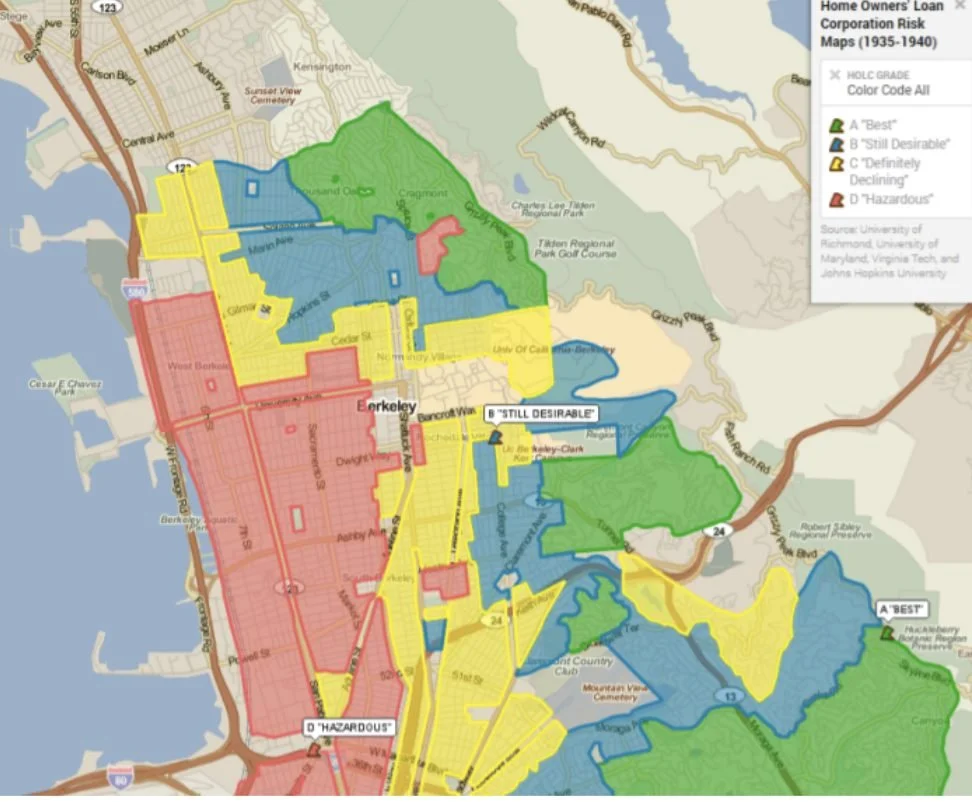
By observing the correlation between these factors and healthcare, I would then be able to visualize my findings in certain ways, such as a graph or a map(which may be better).
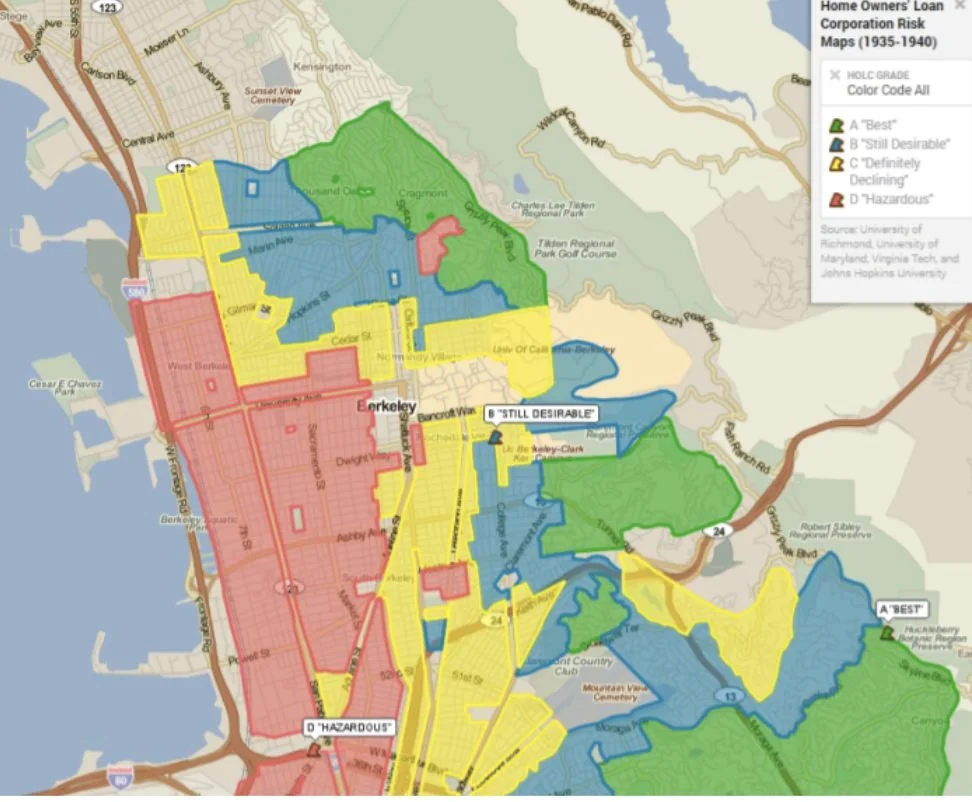
Home Owners’ Loan Corporation (HOLC) ratings of Oakland, Berkeley, and Alameda neighborhoods, indicating in red communities that were most likely to default on loans. (Image courtesy the University of Richmond’s Mapping Inequality project)
Data Analysis
In the process of creating several maps, certain correlations might be observed by noting the relationship between income level and factors such as crime rate or education. By creating the maps, I would then visualize these correlations and find out if there is a relationship between the two. Seeing as I will be focusing on creating maps, my data analysis would be based on comparisons. My analysis would most likely be useful to those who would be working to make access to healthcare more available to all walks of life as they would be focused on making sure that all populations could receive healthcare and that nobody would face barriers to it.
Discussion
There are still additional factors that would need to be measured in gaining a holistic perspective on the city of Berkeley’s community, such as healthcare status, lifestyles, general satisfaction, etc. However, these are usually self-rated as well as specific to a community and individual, so they are harder to measure. In this proposal, we detail a design to visualize the problems faced in Berkeley for the public. By starting with what is quantifiable first, such as focusing on crime rate, health insurance, and income-level, the city of Berkeley acknowledges to its community that it will focus on fixing such problems, and the public is better able to keep the city accountable on its word.
Bibliography
Benns M;Ruther M;Nash N;Bozeman M;Harbrecht B;Miller K; (n.d.). The impact of historical racism on modern Gun violence: Redlining in the city of Louisville, KY. Injury. https://pubmed.ncbi.nlm.nih.gov/32650980/.
Gross, T. (2017, May 3). A 'forgotten history' of how the u.s. government segregated america. NPR. https://www.npr.org/2017/05/03/526655831/a-forgotten-history-of-how-the-u-s-government-segregated-america.
Krieger N;Van Wye G;Huynh M;Waterman PD;Maduro G;Li W;Gwynn RC;Barbot O;Bassett MT; (n.d.). Structural Racism, Historical Redlining, and Risk of Preterm Birth in New York City, 2013-2017. American journal of public health. https://pubmed.ncbi.nlm.nih.gov/32437270/
McClure E;Feinstein L;Cordoba E;Douglas C;Emch M;Robinson W;Galea S;Aiello AE; (n.d.). The legacy of redlining in the effect of foreclosures on Detroit residents' self-rated health. Health & place. https://pubmed.ncbi.nlm.nih.gov/30448354/.
ME;, S. E. O. N. C. P. F. R. (n.d.). The legacy of redlining: Associations between historical neighborhood mapping and contemporary tobacco retailer density in Ohio. Health & place. https://pubmed.ncbi.nlm.nih.gov/33631601/.
Richardson, B. (2021, June 30). Redlining's legacy of inequality: Low homeownership rates, less equity for black households. Forbes. https://www.forbes.com/sites/brendarichardson/2020/06/11/redlinings-legacy-of-inequality-low-homeownership-rates-less-equity-for-black-households/.
