
Technology is constantly making a change in our lives throughout the past decades. One type of technology is currently helping our oceans around the world. Every time you throw away plastic items, they don’t just disappear. Every year, we produce about 300,000,000 tons of plastic, and a fraction of that enters rivers, waterways, and eventually the oceans. Due to sunlight and ocean waves over the years, the garbage breaks down into smaller particles, but still remains plastic, which are called micro plastics. Animals consume these micro plastics for their food, and this leads to the death of many species in various ecosystems. Marine animals infected with chemicals will poison the food chain, which also includes us, humans. Over 5 trillion pieces of plastic currently litters the ocean. If the plastic is left to circulate, it will impact ecosystems, health, and economies.
The Ocean Cleanup conducted its research by going through expeditions, doing lab tests, and research. They used samples of plastic collected from GPGP to develop a new system.Previous cleanup concepts were based on vessels and drones that would be fishing for plastic. These concepts would take billions of dollars and would take thousands of years. The system developed by the Ocean Cleanup will be using currents as its driving force to catch and concentrate the plastic. A large sea anchor in the water will make the plastic move faster than the system, which causes the plastic to accumulate against the system. After the plastic is collected, it will be recycled.
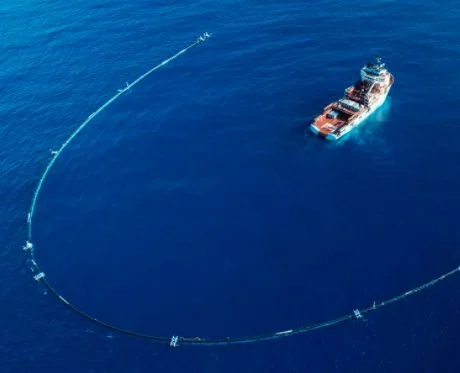
There are 3 problems with plastic that have a potential effect on society. Ecosystem damage: about 800 species could go extinct because of plastic pollution. Economic threat: yearly financial damage of $13 billion on fisheries and tourism according to the UN. Health impact: chemicals affect the food chain. The system is stable, cost effective, and storm resistant. It consists of a network of floating barriers that are oriented in a U shape. The natural currents push the plastic against it and moves toward the center and becomes very concentrated. Because most plastic stays near the surface, the system will be cost effective since it wouldn’t need to be deployed till the seafloor. The system can survive in 95% of weather conditions, with 1 and a half meters below and above the water to catch plastic. It is designed to survive loads up to 80 tons and is smart with motion sensors and camera systems.
Although it takes $31 million dollars to test prototypes and for production, the impact on society is beneficial. Previous cleanup concepts would take about 79 thousand years. It’s slow, expensive, harmful, and inefficient. These cleanup operations will be harmful to sea life and lead to large amounts of carbon emissions. The Ocean Cleanup system can clean up to 50% of the Great Pacific patch in 5 years. It is currently in production for further improvements and was deployed in mid 2018. It has 1 barrier, 1 anchor, and 2 lines connecting them to a central point to buffer the plastic. You might think that the cost of the system is very high or the cleanup rate is slow, but producing this system can have a greater impact on society in the future. The Ocean Cleanup’s ultimate goal is to reach 90% reduction of floating ocean plastic by 2040. So, the next time you use a material made out of plastic, make sure you reduce and recycle in appropriate methods and keep protecting the environment.
Works Cited:
Ocean Cleanup. “The Great Pacific Garbage Patch.” The Ocean Cleanup, www.theoceancleanup.com/great-pacific-garbage-patch/.
“Great Pacific Garbage Patch Is Much Bigger than We Thought.” Radio National, 22 Mar. 2018, www.abc.net.au/radionational/programs/breakfast/great-pacific-garbage-patch-is-much-bigger-than-we-thought/9578816.
National Geographic Society. “Ocean Gyre.” National Geographic Society, 9 Oct. 2012, www.nationalgeographic.org/encyclopedia/ocean-gyre/
Image Credit:
https://blog.marinedepot.com/2018/10/the-great-pacific-garbage-patch-the-ocean-cleanup-deployment-boyan-slat-interview.html
Teens In Health Student Submission Winner
